The Uncontrolled Influx of Syrian Refugees to Lebanon Must Stop

It’s very easy to be taken by enticing principles about humanitarian needs to keep allowing Syrian refugees uncontrolled entry to Lebanon.

It’s very easy to get angry at anyone asking that the influx of Syrian refugees into the country be stopped or controlled. How could you? The Syrians helped us in 2006. The Syrians are being murdered by their own regime in the thousands.

As if we don’t know.

This is not about Gebran Bassil’s recent “remarks.” This is about the people.

In the region of Bab el Tebbaneh in Northern Lebanon, a few tens of thousands of Lebanese live in stinking conditions – even worse than the living conditions of Palestinian refugees in Lebanon’s 12 camps. Are those Lebanese not living in non-humanitarian conditions as well? Shouldn’t those Lebanese be more important to us than anyone else, especially if we were to allocate non-existent resources to better life conditions?

Further north from Bab el Tebbaneh is Akkar, a region that few of us want to even include in Lebanon. Akkar has a lot of Syrian refugees living in horrible conditions. It also has many more Lebanese living in worse conditions. When the Lebanese state has washed its hands of its own people, what can we expect regarding people whose strife the Lebanese government has also washed its hands of?

The most recent numbers regarding Syrian refugees are troubling – 190,000 that include 15,000 Palestinian, adding to Lebanon’s existent population of almost 500,000 Palestinian refugees. I won’t go on and on about demographic changes and naturalization talk because they are 1) irrelevant and 2) not going to happen. Ever.

What needs to be talked about is our ability as a country which can’t take care of its own people to handle almost 700,000 refugees, 190,000 of which are very recent.

The answer is a succinct and quite honest: no way.

Lebanon’s ruling class either talks about closing off an undemarcated border – good luck with that – or about keeping our non-controlled borders in their regular state. They talk about the refugee situation ruining our elections and our society fabric. Frankly, I don’t think they have a clue what they’re talking about. My point of view is not that of Lebanon’s current ruling class which exudes racism with every single word spoken, it is that of one who thinks the families of those refugees deserve better.

Lebanon does not have the ability to handle the Syrian refugees entering its land. We don’t have the ability to give them a better life than the one in their country. We don’t have the ability to keep them safe against families that would kidnap them for negotiation purposes. We don’t have the ability to keep them safe from impeding storms and blizzards that are about to hit our country. We don’t have the ability to ensure their humanitarian rights in any way whatsoever.

So what’s the point?

Do we keep bringing in Syrian refugees into the country to let them die of the cold here? To let them die of thirst here? To let them die of hunger here?

Why are we the only country in the region where the regulation of refugees has to be an obscenely shocking manner while Jordan and Iraq have either shut off their borders completely or regulated the influx into their land? It seems we are the only country who must have everything turn into a controversy.

The Syrian refugees need to stop coming into Lebanon for their own good because we, as a country, will slowly kill them. The solution for the Syrian refugees is for other countries in the region that have no problem shoving Arabism down our throats to man up and host refugees as well – countries which have the resources to build camps and compounds, provide the refugees with shelter and food. I’m looking at the countries of the Gulf, those countries which can’t wait but “stand by their Muslim brothers and sisters” by speech only.

This is not a utopia as some of Lebanon’s politicians want you to believe. We don’t live in a country that can swell to accommodate whichever numbers you throw into it. We are a country that can’t take care of its own people. We are a country that can’t apply the basic laws that should be there to regulate our own lives. We are a country that can’t possibly host refugees. We are a country that’s slowly killing the refugees in it because there’s really nothing else we can do. Do you really want to bring more people in need to our toxic environment?

It is here that I remember the Syrian woman and her two children who died of the cold in Hamra, one of Beirut’s classier districts, a couple of months ago. May they – and all the Syrian refugees dying like them – rest in peace.

Pink – A Short Movie by Lebanese High School Students Inspired by This Blog

Little did I know back when I wrote about my mother’s cancer diagnosis in October that it would inspire a couple of Lebanese students from Batroun to turn my post (click here) into a short movie of sorts.

But Rita Assal and Steve Khattar, helped by a few of their friends including my brother, did. Rita Assal and Steve Khattar are senior (terminale) students at St. Joseph School – my old school – in Batroun. They both want to get into movie-making and I wish them the best of luck in their future endeavors.

They will also be hosted on LBC this coming Monday on the show “Helwi el Hayet” (or whatever it’s called nowadays) whose producers were very impressed with their work.

The video itself is not perfect but that doesn’t matter. What matters is the ambition behind it – the fact that with limited equipment and expertise, students who had never learned movie-making before were able to shoot, edit and have voice overs done. I am also flattered that mom’s story was the catalyst that led to this.

I leave you with Pink:

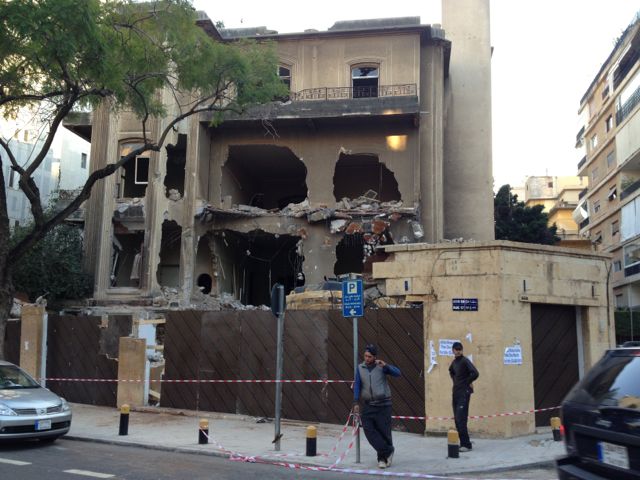
Let Them Demolish Amin Maalouf’s House

Amin Maalouf's Home Beirut

Many people are panicking that Gaby Layon, our minister of culture, has approved the demolition of Amin Maalouf’s house in Beirut’s Badaro neighborhood, which started yesterday. You can check out pictures of what’s left of the house here.

My problem with the issue can be formulated in the following question: should we be against this demolition because it’s Amin Maalouf’s house, which is why most people are outraged, or because it’s is a one-of-a-kind Lebanese mansion that has been around for over a century?

While Amin Maalouf is definitely a Lebanese to make us proud and whatnot, I do not believe him living in the house holds any cultural value for the Amin-Maalouf-Lived-Here protesters. He did not create most of his literature in it. I don’t think the house he couldn’t wait to get out of helped shape him as a writer in any way. If Amin Maalouf wanted the house saved, I’m sure Amin Maalouf could have gotten it saved.

However, the house is more than a century old. It is an old fashioned Lebanese house, present in a capital that is fast losing any form of architecture that makes it distinctive – and this is where the wealth of this residence lies. Long-gone are those mansions that our forefathers helped build and told us about when we were younger. Long gone are those houses that make Beirut Beirut. They are but a distant memory stranded among a concrete jungle of high-rises, slums and Zaitunay Bays. The house shouldn’t be demolished not because Amin Maalouf lived in it but because it would, if renovated, fit in and give grandeur and character to its neighborhood – one that the coming high rise wouldn’t even dream of doing.

Not all old Lebanese buildings are nice and should be preserved though. But their demolition is a reflection of two serious problems: we have a lack of urban design that is only getting worse with each tower ruining Beirut’s skyline. The idea that high-rises shouldn’t be stranded all around the city but located in one main district is non-existent. For example, my neighborhood in Achrafieh has a very high building that hasn’t been completed yet and it’s been ten years at least. It sits there, out of place, out of character and absolutely disgusting-looking. These old buildings are being demolished at an increasingly rapid pace as well – out with the old, in with the ugly new. And this is only the tip of the iceberg when it comes to the horrors of Beirut’s current designs.

The second problem is that those who should care about preserving our culture don’t. And those who have the power to point that out are in a deep state of apathy.

While the issue of electricity and Lebanon’s ancient ruins are different, they are both of the same importance. However, how many TV stations do you see grilling Gebran Bassil day in, day out? All of them except OTV and Al-Manar. How many stations do you see grilling Gaby Layoun for demolishing more landmarks during his time than any other minister of culture? None.

Gaby Layoun isn’t Michel Aoun’s son-in-law. He doesn’t have a protective clout around him. He can be very easily disposed, another Charbel Nahhas if you want.

Gaby Layoun doesn’t have the faintest idea what culture is. He is the minister behind the current demolition of Beirut’s Hippodrome in Wadi Bou Jmil and the demolition of the Phoenician Port in Downtown Beirut as well. For all matters and purposes, this is a man who doesn’t know anything that extends beyond the growing depth of his coffers. And yet he’s still adorning our government with his presence. He was even quoted “apologizing” for Maalouf’s home, not knowing its architectural worth. Please.

Let them destroy Amin Maalouf’s house. What remains of our ancestor’s Beirut doesn’t rest on it. Odds are there’s another house somewhere in Beirut right now being demolished as well. But no one cares. Lebanon’s cultural identity crisis isn’t contingent upon a house standing, in a country whose national heritage is a matter of disagreement, where those landmarks being destroyed are considered by some as unnecessary – “the tourists don’t want to see that.”

Let them demolish Amin Maalouf’s house. It is not his home. It is but a tiny speck in a dying country, a cancerous and corrupt ministry, an idle media and a wretched people all getting ready for Lebanon’s upcoming 2013 elections. I’m pretty sure if the ministry wanted to demolish Gebran Khalil Gebran’s home, few would have cared as well.

Let them demolish Amin Maalouf’s house because, if anything, leaving his old home actually allowed him to be great. 3a2belna.

Les Misérables [2012] – Movie Review

les-miserables-movie-poster

As a person who grew up and went through a French curriculum with Victor Hugo’s novel as its centerpiece at many points, I’ve grown attached to the essence of the novel. I’ve also grown to understand it, know what it contains, understand the message that Hugo wanted to pass on. I’d even joke and say the novel’s impressive spine is a byproduct of Hugo being French – a lot of blabbing for nothing. I’ve taken some of that, as is evident by my wordy blogposts at times. This review will surely turn into one so just skip to the last paragraph if you don’t feel like reading.

My knowledge of Victor Hugo’s most famous 1500-pages novel has led me to conclude that it’s very difficult to turn it into a motion picture. If the previous attempts at this novel weren’t enough proof, Tom Hooper’s take on Les Misérables adds to the growing list of not-nearly-there trials.

The story is known for everyone by now. Jean Valjean (Hugh Jackman) is a French man living around the time of the French revolution and is forced to steal a loaf of bread to save a relative’s life. He is subsequently thrown in jail for 19 years at the end of which he’s released on parole. Valjean, however, breaks his parole and ends up making a decent life for himself as the mayor of a small French town in Northern France called Montreuil-sur-Mer. But Javert (Russell Crowe), the prison warden who was in charge of Valjean, appears back in his life during a visit to the factory run by Valjean, now working under a new name. In that factory works a single mother called Fantine (Anne Hathaway) who gets sacked from her job when her secret of having had a child out of wedlock, Cosette (eventually played by Amanda Seyfried), is discovered. Fantine eventually succumbs to becoming a prostitute and is saved by Valjean who promises to take care of her daughter as he runs away from Javert who’d do anything to catch him, to the backdrop of a growing revolution in the streets of the French youth.

Tom Hooper’s Les Misérables is a full-blown musical. No, it’s not a musical in the sense of a talking movie with a few songs interspersed here and there. It’s a musical in the sense of three hours non-stop singing where even “thank you”s are sung, where reading letters becomes melodic and where, if you’re not a fan of musicals to begin with or not entirely sure what you’re getting yourself into, you’d end up wanting to pull your own hair out. Yes, this version of Les Misérables is definitely not for everyone. Even if you love – scratch that – adore music, Les Misérables might prove a very tough pill to swallow. And at times it really, really is.

Hugh Jackman, who can sing, ends up grating around the 120th minute mark. Russell Crowe on the other hand entirely sheds his Gladiator image for a singing Javert and with his not-so-pleasant singing voice ends up entirely intolerable a few minutes in. Russell Crowe even looks entirely uncomfortable to be there and it reflects on his character, making Javert – a central figure to the story – comical at times. Hugh Jackman has to be commanded for a job well done as Valjean. Few actors can say they can deliver performances as he did with the close-ups he got throughout the movie.

In fact, the actors and actresses in Tom Hooper’s Les Misérables all performed their songs in the movie live. While a piano played in the background to guide them, they acted their songs instead of recording them months in advance and eventually lip-synching them to film.

The single acting performance in the movie that will absolutely blow your socks off is Anne Hathaway, who’s probably aided by the fact that her character isn’t there for long. Hathaway, as Fantine, is brilliant. She deserves all the praise she’s been getting. Her performance of the Susan-Boyle-made-famous song “I Dreamed A Dream” is gut-wrenchingly stunning. She brings the life into her character and gives Fantine a richness which other actors in this movie with more running time couldn’t bestow upon theirs. Hathaway steals every scene she’s in and ends up being the only reason you might walk out of this movie feeling like you hadn’t wasted three hours of your live. Just to watch her do what she does so beautifully. No one is raining on Hathaway’s parade come Award-season time.

Interesting casting choice include Samantha Barks as Eponine, the daughter of the Thénardiers, played by Helena Bonham Carter and Sasha Baron Cohen whose only purpose was to add some comic relief to some tense moments. Barks sings her songs really well and gets you to relate to her character, despite the background. She delivers a nice rendition of “On My Own.”

Les Misérables does have its strong moments, notably the opening scene, Hathaway’s minutes and the ending, but the movie accumulates a lot of off-moments as well that make the result very lopsided. The movie is also extremely long. Thirty minutes (of wailing – singing) could have easily been cut with the story not be affected because few of those songs tell us more about the character and its story, an example being I Dreamed A Dream in which Fantine tells the story of how she reached the misery she was in. The overall result is a movie that feels very in limbo: okay, not great, this is awesome, this is horrible, goosebumps, kill me now. These are all things you will feel while watching Les Misérables.

3.5/5 – – new rating system.

Beirut’s Valet Parking Saga: 3enab, Gemmayze

In February 2012, the story about how a Zaatar w Zeit valet parking hassled and then hit someone who was trying to park in front of ZwZ in the early AM hours made the rounds. It sparked outrage (which naturally eventually died away) and even made it to the news. You can read all about it here.

The time of the following story is a few months later, on December 29th 2012, when a friend of mine named Jad Rahme tried to park in front of 3enab in Gemmayze and was hassled by the valet parking person and then by the restaurant’s manager. His story is currently gaining attention on Facebook (link) and I figured I’d help with sharing it as well:

Yesterday night at 0:45AM we parked in front of the restaurant Enab Beirut in Mar Mikhael. The valets come to us and tell us that we can’t park here because they keep this place empty for the restaurant. That’s the second time I face the same issue in front of the same restaurant and the first time I called the manager who apologized and told the valet to let me park. So that’s what I did yesterday but it seems like this time the manager took it as a personal issue against the restaurant. 

The manager made it clear that I can legally park here but that he don’t want me to park here because he wants to keep the place empty in front of the restaurant. To make it short, after hearing lovely words from the manager like “Akalna khara haydik el marra” and after he shouted “Iza 3ambtethaddene soff hon w fell” we left because we suspected that this will lead to the valet scratching the car or doing any similar vandal act.
I don’t know how many clients they will lose if we park in front of their restaurant at 1 in the morning but what’s sure is that they lost me as a future customer because I was planning to try this restaurant after hearing some good stuff about it in a family lunch few months ago.

To all the older generation who keeps on telling us “We count on the younger Lebanese generation to make this country a better place”, what do you expect from us if we can’t even park on a public parking spot? If we can’t park in a public spot that is meant to be for anyone how do you expect us to solve bigger problems like infrastructure and electricity?

With the hope that one day Lebanon will be run by a state and a government rather than valets and NGOs.

3enab is a restaurant that has been mentioned on my blog before to point out its severe breach of the smoking ban, despite sporting a sticker on its main door advertising a non-smoking environment. You can check the pictures here.

Despite reporting the place, the authorities didn’t even bother which is proof enough – at least to me – that our so called tourism police is in with our restaurants to violate the smoking ban. How many restaurants actually respected the no-smoking law on New Year’s Eve? Almost none.

Regarding the issue at hand, I personally always try to find a place to park without resorting to Valet Parking. But anyone would tell you that trying to park anywhere in Achrafieh on a Saturday (or any other day for that matter) is a near impossible task. I know it shouldn’t be this way but what can you do?

If, by some stroke of bad luck, I end up having to park somewhere in front of a shop, the least that I should theoretically expect is not to be bad-mouthed or hassled or even beaten. But Lebanon is all except theoretical. The police which couldn’t care less about the smoking ban won’t care about an issue that’s been going on for far longer. The authorities which have no problem eating away your rights whenever they feel like it won’t be bothered by some valet parking employee hassling you.

Sometimes things are just the way they are and you can’t really hope to change any of them. With each passing day, this is becoming my realization towards my country. I may love it to pieces but how can I expect to make those needed massive changes when a parking spot has become a commodity, when demanding for a law to be applied is met with apathy, where regulatory laws are always met with ridicule and where those who should look after you only care about looking after themselves?

This is 3enab’s Facebook page (here) if you feel like complaining.