Anna Karenina [2012] – Movie Review

Anna Karenina Joe Wright 2012 movie poster

Joe Wright, the director who gave us “Atonement” and “Pride and Prejudice” tries his hand at one of Leo Tolstoy’s most popular novels and does so by going bold via a new cinematic vision that’s never be done before.

Anna Karenina, the story we all know of the woman who after being tormented by an uncaring husband seeks companionship in a much younger suitor, is given a fresh approach in Joe Wright’s version. The movie has a theatrical aspect that is most definitely quirky. If you are able to get past the weirdness of it, Anna Karenina will prove to be a highly enjoyable movie. If not, then it’s two dreary hours for you.

Keira Knightley gives a great performance as Anna and is definitely helped by the setting the director envisioned for the movie. She brings a ton of sensuality and sexuality to the table, as she has previously done with similar period pieces. Her best scenes, however, are as much a product of her own acting chops as they are of the art direction, camera angles and whole vision. Newcomer Aaron Taylor-Johnson, whom you’ve probably seen before in Kick-Ass and Nowhere Boy, gives a terrific performance as Count Vronsky, Anna’s younger lover. His performance is definitely years older than his young age of 22 and he delivers the right amount of emotion and subtlety that the character requires. Jude Law is almost unrecognizable as Anna’s husband Alexei Karenin. His role, however, borders on the irrelevant at times due to his grossly underdeveloped characters and that’s one of the major flaws in this adaptation.

Joe Wright’s Anna Karenina, while visually enchanting, is flawed when it comes to character development. If you haven’t read the book, Anna’s movie character comes off as a bored housewife whose husband couldn’t satisfy her anymore while, in fact, it was Anna’s husband who drove her to cheat on him but constantly shutting her out. This is not portrayed in the movie. Alexei Karenin is shown as a near saint who can’t understand why his wife would cheat on him and who’s ready to forgive her despite all odds so that by the time the end credits roll, your sympathy towards Anna, the movie’s main protagonist, is next to none.

This adaptation of Anna Karenina is fresh and energetic, risky and ambitious but it’s more about image than it is about content. What Joe Wright did was infuse some sense of modernity into this nineteenth century tale which might get it to connect with a younger demographic that’s not all too willing to read the keystone-sized book. Anna Karenina is one of the most visually inventive movies of the year and despite that taking out some substance, I was still taken away by the world portrayed on screen. However, all in all, the movie is nothing short polarizing, starting with Wright’s new take on the art direction to the way the screenplay was written, culminating in the finished product as a whole. I personally really liked it – but I can see why others would absolutely hate it. Anna Karenina is a movie that seduces you but ultimately fails to break your heart as the ice-cold train wheels break hers.

8/10

The Sleepless Nights of Lebanon’s Tripoli

If you go by the geography they teach at Lebanese schools, you are taught that Tripoli is the second biggest city of Lebanon and the capital of its Northern governorate.

The geography they taught us at school also enumerated the numerous economic riches that Tripoli boasted: its port, its proximity to the border, etc….

The civics course they gave us at school tells us about the numerous touristic advantages of the city of Tripoli: its castle, its old souks….

The sociology they taught us at school mentioned how Tripoli has one of Lebanon’s poorest regions on its outskirts. It’s mentioned only fleetingly, like something we can’t wait to bury under a pile of blissful ignorance as if it’ll make everything okay.

If you look at the latest events taking place in the country, you’d think our Northern border is not at “Al 3arida” but at Balamand. You’d think those Lebanese people of Tripoli have been annexed to the Syrian war. You’d think that this Lebanese city that many find too easy to hate is no longer Lebanese – just a burden that we can’t wait to get rid of. Let’s return it to pre-1920 days when it wasn’t part of our favorite part of Lebanon, Mount Lebanon.

My friends in Tripoli haven’t been sleeping lately. But you’re not hearing about that. You’re not hearing about the explosions going off at any moment, the bullets piercing through the silent December nights. You’re not hearing about the people dying, the children getting shot.

You’re not hearing about the people like you and me cowering away at a corner of their house all night in fear that one of those stray bullets might do them in.

It seems as if our Lebanese media has washed its hands from Tripoli. That city is just not worth the coverage – it’s a “been there done that” type of things. They’ve covered similar incidences there before. What’s the use of covering them now? It might go well with their policy of “let’s show only the good side of Lebanon for the world in order to save the Christmas tourist season.”

Our politicians couldn’t care less as well – as long as they get their share of votes next year. This city, which has one prime minister, four ministers and a bunch of MPs, has no one to speak on its behalf. It only has people who preach about what should take place as they sit in gilded seats somewhere far, far away.

“We condone the presence of arms in the city.” You often hear say. And what will your condemnation really do, mr. politician, while you’re the one secretly buying your people weapons in order to fuel the struggle that you know will bring you loads of returns in a few months’ time?

I am not from Tripoli. But Tripoli is one of my favorite cities in this God-forsaken country. It saddens me to see ignorants portray my friends as a bunch of Islamists who deserve whatever’s happening to their home. It saddens me to have people panic beyond their minds how I had to drop off a friend in Tripoli around midnight a couple of days ago. It saddens me that with each passing day, Tripoli is stripped from the identity of a city where Muslims and Christians lived side by side for years and is portrayed as a place where the next Islamists Emirate will start from.

When it comes to Tripoli, the majority of Lebanese have one thing to say: “On n’est pas concerné.”

Alternatives To The Viber Ban in Lebanon

In case you didn’t know, Alfa has blocked Viber on its 3G network and MTC will follow suit later on seeing as the demand to stop Viber came from the ministry of telecommunications.

I don’t want to go into speculation as to the reason of the ban and I have asked the minister on twitter about that but he didn’t reply. It seems this whole #ProtectPrivacy balderdash only works when it’s aimed at your political opponents. This is proof that what I said is true – the ministry doesn’t give a rat’s ass about your freedom except when it serves them politically.

Incidentally, Lebanese Twitter and Facebook users were not up in a fit about this as they were about #ProtectPrivacy thing. Guess it only works when they’re driven by some politician. It feels good to be right.

Anyway, seeing as Viber is not the only VoIP app available on Apple’s AppStore and Google Play – or whatever that store is called, I figured I’d make a list of other apps that you can use and which haven’t been blocked yet. The VPN fix requires you to pay for a subscription eventually. Hopefully by the time they block all other viber-like apps, some Lebanese would have seen through all the ministry’s bullshit and decided to call them up on it.

1 – SideCar (iOS/Android):

This is a whatsapp alternative that also allows you to call those that have activated it on their numbers. It’s also free.

2 – Vonage (iOS/Android):

This app allows you to call US and Canada numbers for free and most importantly, it lets you call other people who have Vonage.

3 – Tango (iOS/Android):

Has the same components as Viber and then some more such as video chats.

4 – Fring (iOS/Android):

Allows free calls, video calls and free group calls to those who have it activated on their number.

Lebanon Described in 1982

I’m currently reading the book “From Beirut to Jerusalem” by Thomas Friedman, in which he tells parts of his stay in Beirut between 1979 and 1984, as our civil war raged on.
While some parts so far are not entirely correct or too autobiographical to be generalized, the read is very interesting to say the least.

The excerpt I’m quoting is the most interesting part of the book so far. What rang true in 1982 still resonates today – and Friedman has to be commended for having the mind to see it, especially as an American Jewish outsider whose stay in Beirut was nothing more than an experiment.

“The real problem with the Lebanese today is that they have gotten too good at this adapting game—so good that their cure and their disease have become one and the same. The Lebanese individual traditionally derived his social identity and psychological support from his primordial affiliations—family, neighborhood, or religious community, but rarely from the nation as a whole. He was always a Druse, a Maronite, or a Sunni before he was a Lebanese; and he was always a member of the Arslan or Jumblat Druse clans before he was a Druse, or a member of the Gemayel or Franjieh Maronite clans before he was a Maronite. The civil war and the Israeli invasion only reinforced this trend, dividing Lebanese into tighter-knit micro-families, or village and religious communities, but pulling them farther apart as a nation”

This goes well with a previous description from over 140 years ago. Some things look like they’ll never change.

Amour [2012] – Review

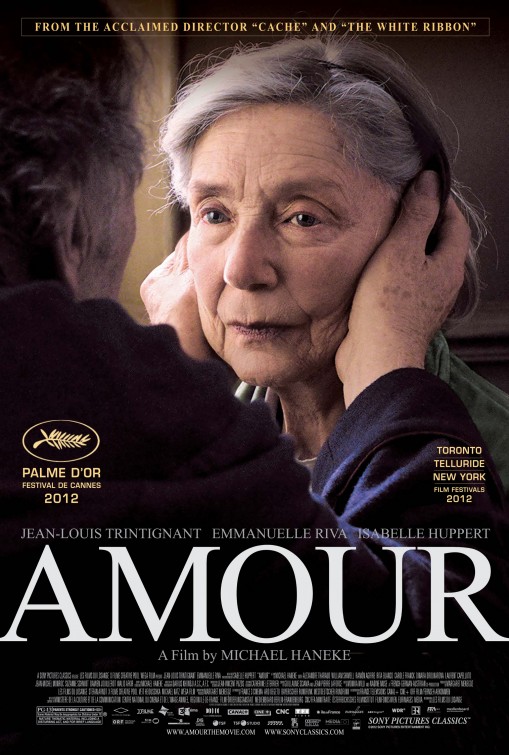
Amour 2012 Movie Poster

In an old Parisian apartment, with its yellowing books, rusty sinks and creaky tables, Georges and his wife Anne, two eighty year old former music teachers live. They go about their lives normally, attending concerts of former students, going through family albums that remind them of their younger days and caring for each other after all the time they’ve spent together. “C’est belle, la vie,” Anne says.

One day, as they’re having breakfast, Anne stops responding to Georges’ talk. He looks into his wife’s eyes and sees nothing there – she remains transfixed, unresponsive, a shell of the woman she was a few minutes earlier. He damps up a towel with water and tries to wipe her face but to no avail. As Georges gathers his things to call an ambulance, his wife comes back – but Anne has had a stroke. A carotid-stent operation going wrong later, Anne needs Georges to take care of her all the time, which he’s more than willing to do. A second stroke leaves her with right side hemiparesis, her right hand curled up in a fist. But Georges keeps taking care of his wife. He brings her a nurse three days a week, tries to sing with her “Sur Le Pont D’Avignon” when she can’t speak anymore, tries to get her to drink water when, in the rare lucid moments she gets later on, the only thing she makes him know she wants is to die.

Boasting beyond brilliant performances by Jean-Louis Trintignant and Emmanuelle Riva as Georges and Anne respectively, Amour is a heartbreaking, stunning and chilling portrayal of life in old age. Georges, the husband giving his all to care his dying wife, reaches a point where he knows what he’s doing is not enough but he keeps going anyway. The husband’s resiliency facing his wife’s forced surrender is a contrast that transcends the confines of the previously described Parisian apartment they both live in, which is the movie’s only setting though never feeling claustrophobic. The clash between the wife who wants to die and the husband who wants nothing but for her to live boasts an intense aspect of humanity that many movies fail to grasp even if they tried to. The nuances in the actors’ performances are striking. The way they look at each other through their wire-rimmed glasses, the adoration that radiates off Anne’s cheeks towards her husband… those are things you come across very rarely and you can’t but appreciate them when you do.

One of the main reasons Amour is this brilliant is Michael Haneke, the Austrian director, who has also written this great screenplay of life, love and death. The visual style he gives the movie is masterful. The pace he sets is poignant, never faltering. The movie he made draws you in, grasps and doesn’t let go. His style is shocking at time such as in Georges’ last act of love towards his wife, a stunning scene that will leave you haunted.

At a certain point in Amour, Georges tries to give Anne water, and she lets it roll angrily down her chin with a look of violent denial of life. Georges unwillingly slaps her, then apologizes like the exasperated caregiver he had become. Later on, he tells her stories of a time when he went to camp he didn’t like. He had agreed with his mother to write her daily. If he had liked his day, he’d draw flowers. If not, he’d draw stars. Amour shows us that life is a mix of flowers and stars. The love this old couple has to each other is the true embodiment of in sickness and in health. Amour is so intimate that watching it feels like you’re prying on these people’s private lives. It is so heartfelt that you can’t but feel touched by what you see. Amour shows you love. And it shows it spectacularly.

10/10