Meet Amanda Saab, The Lebanese on US’ Masterchef: Changing Stereotypes & Shining With Lebanese Food

Amanda Saab Masterchef USA

Meet the awesome Amanda Saab.

A few weeks ago, an acquaintance of mine was gushing about how excited he was that there was a Lebanese candidate on this season’s Masterchef, which airs on FOX every Wednesday in the US.

On that episode, Amanda Saab had done a fusion cuisine dish, based on our very own Lebanese pride and joy: it was kefta with sumac aioli and jalapeño-dusted potatoes. Her favorite comfort food? Kebbeh nayye.

From that moment on, it’s only been looking up for her. She’s now considered by many to be one of the show’s front-runners. Amanda and I have spoken a couple of times on Twitter, and I’ve noticed how many people are rooting for her whenever a new episode airs. She keeps getting attention the more she progresses. But this is not only what’s impressive about Mrs. Saab.

Originally Lebanese and born in Michigan, when Amanda Saab does not cook, she works as a social worker in Seattle where she lives with her husband, Hussein. Cooking was her way to deal with the grief and horrors she witnessed in her every day job. Her inspiration cuisine is Lebanese, but she likes to add twists to it.

Amanda Saab is also the first Muslim candidate to go on the US’ Masterchef. She’s also the first veiled woman to go on any American primetime TV show.

I’ve been following up with news around Masterchef for a while now, and it’s safe to say that Amanda Saab is changing minds about Islam, about Muslim women and about Muslim-Americans for the general American audience.

This is to say that even if Amanda Saab does not end up being the show’s overall winner, which I do hope she is (the show has already been filmed), with her participation in Masterchef, she’s challenging preconceptions that Americans have about women in headscarves: when they’re seeing Amanda follow her passion, and do it in such a glorious way, they can’t but reconsider what they thought they knew.

At a time when the only news of Islam that’s propagating around the world is ISIS and their terror, Amanda Saab  is showing that there’s another side to Islam, and it’s people like everyone else, with scarves or without, who can cook and who can’t.

Ramadan Kareem and good luck to Amanda!


When Arabs Think The Apocalypse Is Near Because The US Legislated Same-Sex Marriage

I’m so honored and flattered to be living in the most open-minded and widely-accepting region of the world. Not only is everything peachy, wonderful and exceedingly rainbow-y around this place, but people in the region are adamant that their quality of life is obviously the way to go for everyone else, and that any deviation from it is quite clearly going to bring about the end of days, Allah-style.

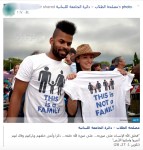
It only took a couple of hours after the United States legislated same-sex marriage on Friday for Arabs across the Middle East to rise in outrage. Obviously, the outrage was restricted to Facebook and Twitter, but some of them were absolutely seething.

Here’s a sample:

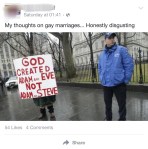
How can anyone fathom living in a place where people are equal and requested?

I mean look at Iceland. They have more books published per person than any other country in the world while still being the second happiest country in the world. They legalized same-sex marriage in 2010. How dreadful.

Look at Belgium. The UNICEF called it the best place for children in the world. They legalized same-sex marriage in 2003. How atrocious.

Look at Canada. They are, according to studies, the most educated country in the world. They legalized same-sex marriage in 2005. How horrifying.

Look at New Zealand. They’re the second least corrupt and fourth safest country in the world. They legalized same-sex marriage in 2013. How abysmal.

Look at Norway. They legalized same-sex marriage in 2001, and they’re #1 on the UN’s Human Development Index. How disgusting.

Look at Ireland. In May 2015, they became the world’s first country to legislate same-sex marriage via a public referendum. They’re the #10 in the best places to grow up in. How nauseating.

Obviously, a #GAY_HOUSE is not a suitable place for humanity, because it will destroy everything that we’re about:

Arabs US - 15


So, because those horrible same-sex-loving countries are downright appalling at how they do things, I think that we should tell them what “natural” is, because they don’t know, and because we’re excellent at keeping things natural:

  1. It’s okay to have ISIS in your backyard. Clearly, there’s nothing wrong or unnatural about a clan of beheading-loving terrorists who are emanating from our #NATURAL_HOUSE.
  2. It’s okay if you marry an 8 year old girl. As long as the person you’re marrying has a vagina, you’re okay. Also, it’s not pedophilia in our #NATURAL_HOUSE.
  3. It’s okay if you beat your wife to death. The law allows it. No one will bat an eyelash on the news of her ending up in the hospital, brain dead. No one will also care about the bruises on her face. This is how we roll in our #NATURAL_HOUSE.
  4. It’s not okay for you to marry someone who inherited a different set of religious beliefs. Sunni and Shiite can be okay, even though you wouldn’t want that for your children nowadays also. But Muslim-Christian? This is not how things work in our #NATURAL_HOUSE.
  5. You will not be naturalized in our countries unless you’re from a certain religion. It doesn’t matter how good of a person you are, how hard-working, law-abiding and national. We don’t want any strangers in our #NATURAL_HOUSE.
  6. If you hear someone talk about the idea of civil liberties, call them a heretic and hang them at your nearest town square. Civil marriage? Equal right? Human rights? These are foreign concepts in our #NATURAL_HOUSE.
  7. If someone dares to mention Western countries, you will point your finger to his or her face and accuse them of being a follower of the Great Big Shaytan. This is not an insult to anyone’s intelligence in our #NATURAL_HOUSE.
  8. You will bring up Gaza and other violations of human rights in casual conversation about irrelevant topics, over shisha with your friends, to show you care. We are compassionate in our #NATURAL_HOUSE.

Once upon a time, I used to be a homophobe bigot. I used to think what people did in the privacy of their homes was my own business, and that I was allowed to have an opinion into how other people lived their lives, and that their lives are supposed to go on the track of values that I was exposed to all my life, never challenging, never looking at another realm of morality that existed beyond the confines of that little town, nestled on the hills of Batroun, in the heart of Christian Lebanon.

This extended to the way I dealt with things as well: when the only thing you know is that different is not okay, that “other” is frowned upon, that anything existing beyond your moral code is cringe-worthy, you slowly but surely regress into not being human.

But then I left home, and I realized that there were a lot of things I didn’t know. I realized that being challenged, morally, by things I had never been exposed to wasn’t only mind-boggling, it was also exhilarating. And slowly, over the course of many years and friendships in between, I not only do not recognize the boy that I was a few years ago, but I cower at the idea of that person still existing in some people’s memory.

I’ve seen some people say that discussing the new American legislation should not be done by people not living in the United States. I believe it’s the exact opposite. The most heart-warming story I’ve seen over the weekend is how a friend of mine, whose mother thought homosexuality was an abomination only a few years ago, is now a person who just wants people to live and let live, because what they’re doing does not affect her in any way whatsoever.

The more we discuss such topics and issues that challenge what we know, the more we inch towards truly bettering ourselves as societies, crawling slowly but surely towards a better state, one where people realize that the people who are different in all aspects are not an issue, but not accepting them is.

Dear MTV Lebanon, Lebanese ARE Racist

There’s plenty that MTV could have covered in their news: A failed 25th attempt at electing a president, more debate and analysis over the Roumieh torture videos, SaudiLeaks cables, etc… The same applies to any Lebanese TV station, clearly.

Instead of covering what actually matters, however, MTV decides to be offended by a Ramadan series aired on its rival LBC. Why? Because, and I quote MTV, “it’s showing Lebanese in a wrong light by portraying them as racist towards Syrians.”

I’ve watched the video over and over again. I honestly have no idea what that TV station is smoking or what that reporter is drinking or what country Naccache is located in because it sure doesn’t feel like the country I’m in.

This is the report currently making rounds, and which will make your blood boil for its sheer narrow-mindedness, lala landness and utter ridiculousness:

I don’t know about MTV, but let me talk about the Lebanon I come from.

1) A few months ago, my hometown decided to enforce a curfew on Syrians. Because that wasn’t enough, some men decided they wanted to form night guard duties, weapons and all, against those Syrians. It wasn’t even a hidden thing. It was a Ebrine normality. In between their “guard” duties, some of those men physically assaulted many Syrians simply because they existed outside of their rooms beyond their forced curfew. A pregnant Syrian woman had to take permission to go out of her house to the hospital to give birth. And the examples are ever-flowing. You can read this article for more info (link).

2) A couple of years ago, Annahar decided to go around Beirut and ask a few Lebanese what they thought of the Syrian refugee presence in their countries. The result was the following video:

I’m particularly interested how someone saying, and I quote, “there are so many Syrians here we might as well call it Syria,” qualifies as tolerance. Or how “I’m afraid of walking on the streets now because there are more Syrians than Lebanese” is a sign of progressiveness. I digress. Let’s proceed.

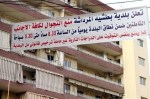
3) Since MTV was beyond pissed about how that TV show portrayed Achrafieh, let’s see what was all around Achrafieh just a year ago. Luckily, the internet is a beautiful thing, so pictures are aplenty and here are pictures to you:

Again, I’m trying to see how such signs, years after the withdrawal of Syrian troops and a clear manifestation of Christian xenophobia in a heavily Christian region are an indication of how tolerant and open minded we are as Lebanese.

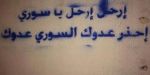
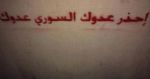
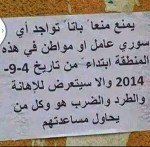
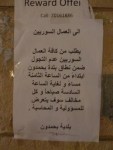
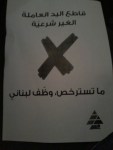
4) With the influx of Syrians into the country, many municipalities, like mine, decided to start curfews for Syrians. Many took this a step further as well. Some places had political parties also come up with posters for the purpose of doubling down on the increasing Syrian presence in Lebanon:

The posters translate into the following: “No Syrian is allowed in this area starting this date or they’ll be insulted, beaten along with whoever’s helping them.” Another one says: “Boycott illegal labor. Hire Lebanese.”

Nothing was done about this back then. Few were the voices that called these as they were, racist and degrading. But we went about our days normally. Have a TV series give the narrative to a Syrian FICTIVE character? Oh Lord no, our Lebanese oversensitive pride won’t have that.

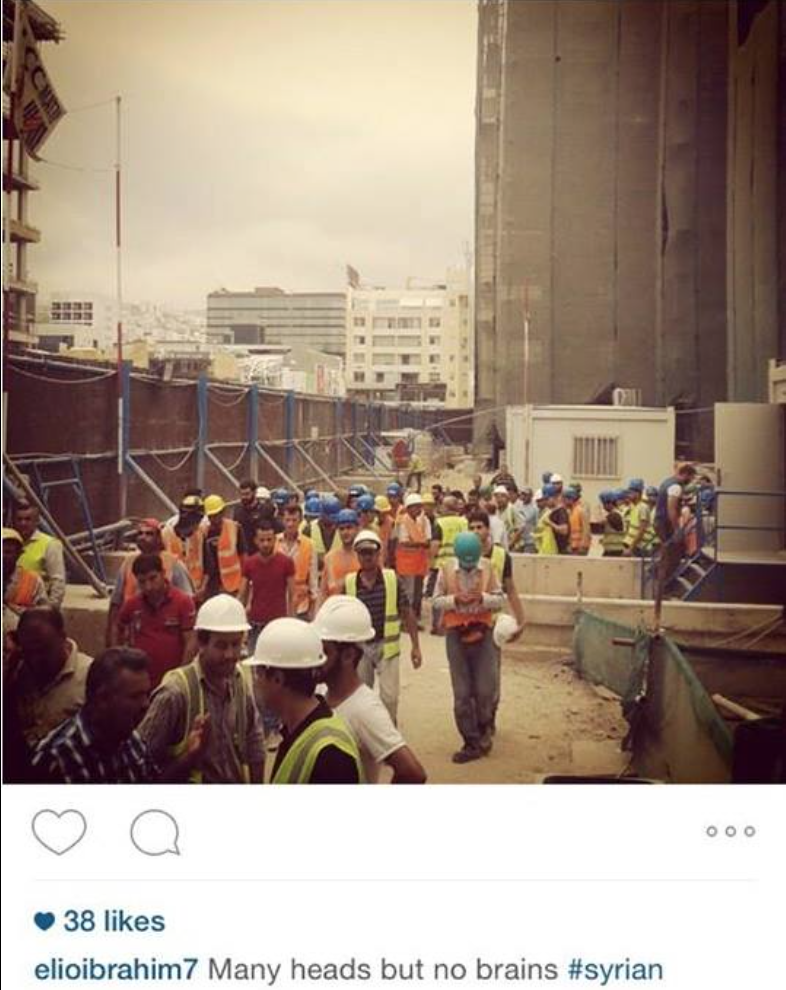
5) It’s been only two days that the following picture made the rounds on social media. An AUB student took a picture of Syrians and captioned it, on Instagram with filters and all: “Many heads, but no brains. #Syrians.” The outrage at that student was entirely political. I’m willing to bet most of those outraged at him were so simply because his political background serves as fuel to their own political hatred, more so than for them being caring about Syrians per se. But still, it clearly shows that such mentalities exist today and are aplenty.

Syrians Racism Lebanon

6) Now that we’ve established that MTV lives in a separate realm of existence (let them talk to Stephen Hawking, he’d be interested), let’s go over a quick survey of the many things we’ve all heard about Syrians and Syria, among people that we all know: Oh look, a Syrian. Oh, there are too many Syrians, be careful. The best thing to come out of Syria is “el festo2 el 7alabi.” And let’s not start with all the homsi jokes, which is when we are taught to be racist towards Syrians the moment we become aware.

But dear MTV, many Lebanese are not racist towards Syrians only. They’re also racist to those of nationalities they deem lesser.

Don’t you remember the guy who wouldn’t shake hands with people who are black?

Don’t you remember that Mothers’ Day ad about special offers on maids?

Don’t you remember the countless MEA reports about racism aboard their airlines? 

Don’t you remember the many maids that lost their lives to abusive employers and have no laws to protect them?

Don’t you remember that picture of the purse getting a seat while the maid remains standing as her family has lunch? 

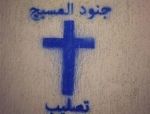
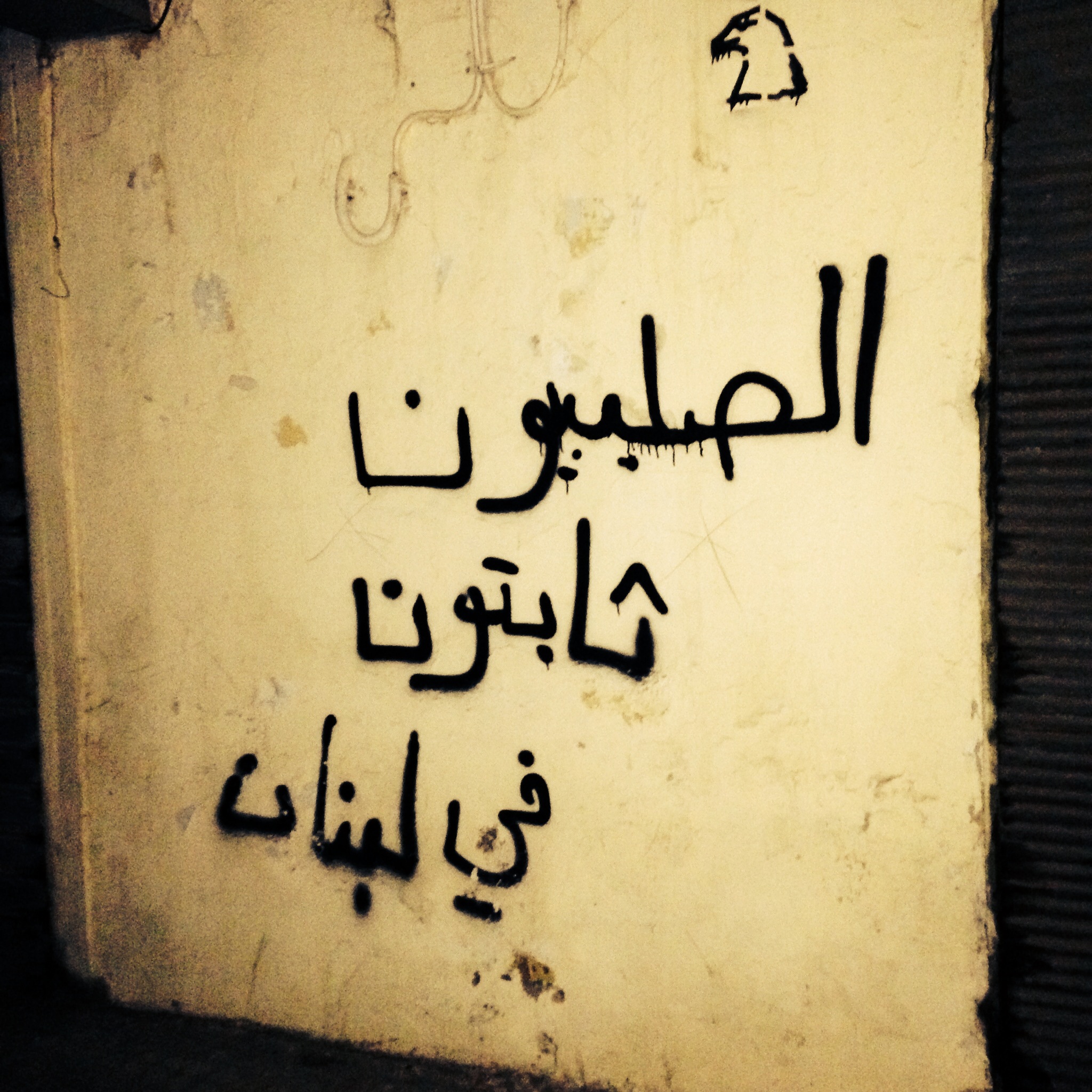
We’re not only racist towards other nationalities. We’re also racist to each other. If you walk around MTV’s beloved Achrafieh, you are bound to find plenty of “Ra7 Tdall Jrasna Tde2” graffiti plastered around red crosses. Those newly coated with paint to keep their memory as fresh as their color. Who do you think they’re targeted to? Let’s just say it’s not someone who worships the Cross. For reference, I also have this to look at every morning:


People in Keserwan have endless stories about them chastising “el gharib.” The people of Tripoli are ridiculed by many because of the situation in their city. I have friends from Tripoli who changed their city on their CV because they know it decreases their chances to get hired. But please, tell me more about how we are not racist.

This isn’t to say that every single Lebanese is racist. There are many movements across the country to combat such mentalities. There are many people who are as far from racism as MTV is from being an objective and decent news outlet. The inherent problem isn’t only racism, it’s us pretending that there isn’t such a problem to begin with, it’s outlets like MTV – with substantial power and reach – engorging the ever-growing Lebanese ego, tapping it on the back, and telling it that there’s nothing wrong with you.

Fixing the problem starts with acknowledging it, not being offended by its existence. This is just shameful.

A Love Story From The War-Torn Rooftops of Tripoli To Lebanon

Love and War on the Rooftop - a Tripolitan tale

Welcome to Lebanon’s Tripoli, the city most of the country loves to hate.

A few months ago, whenever Tripoli was mentioned in casual conversation, it would be surrounded by a spew of sectarian hate speech. That conversation you heard or maybe even pa
rticipated in probably lacked depth, was never in context, always judgmental and served to further deepen the chasm between this Northern city and the rest of the country.

There’s nothing in this country that’s a more heart-breaking story or tragedy than the current state of Tripoli. Boasting the country’s biggest old souks, richest people, most important architectural feats and second largest population, it is also the country’s poorest, least developed, least cared for and least acknowledged place.

A lot can be said about that city, and I have over, and over, and over again. One thing for sure, however, is that the potential that Tripoli has is gigantic, if only we can tap into it. Lebanon’s NGO March, which you’d know from the popular Stop Cultural Terrorism in Lebanon page, have done just that. 

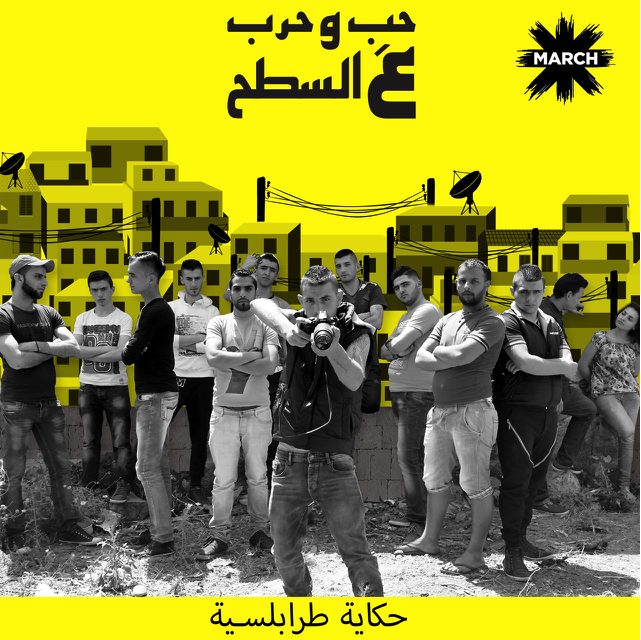
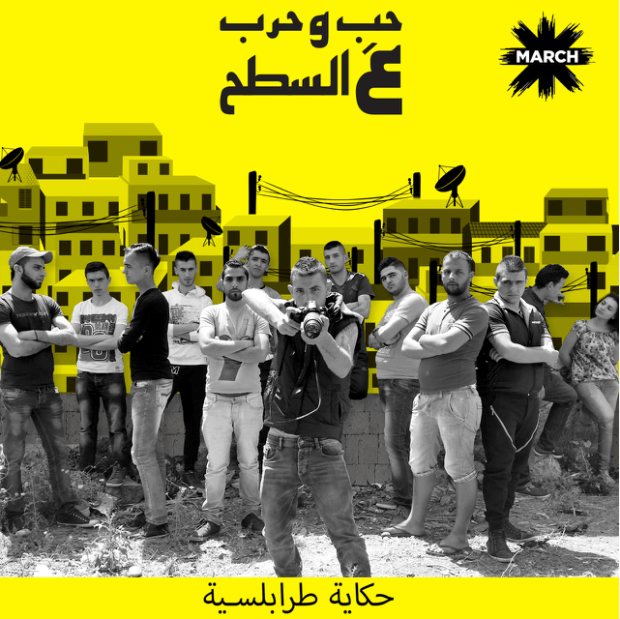
Over the past 4 months, director Lucien Abou Rjeili gathered together 16 young men and women from Tripoli’s Bab el Tebbeneh, Ebbeh and Jabal Mohsen neighborhoods and embarked on a conflict resolution project with them, in order to build bridges and see what can come out of it.

Those men and women were, prior to those 4 months, on opposite sides of Syria Street, witnesses to the bullets and rockets being fired by people they perhaps know, convinced that the person across that green line was their enemy until Kingdom come. Well, kingdom came.

Through acting exercises with the likes of Nadine Labaki, Georges Khabbaz, Rafic Ali Ahmad, those 16 men and women found themselves not looking at each other as enemies, but as friends. Instead of being wary of going to the sessions, they became excited. They’d want to go, see their friend from Jabal Mohsen or Bab el Tebbaneh, and maybe even hang out with them afterwards.

In the midst of that, those 16 men and women got threats. What they were doing did not sit well with higher up forces who know that their true power can only be fed by hate being present all the time between Jabal Mohsen and Bab el Tebbaneh: friendship, amicability and humanity should not be allowed.

Those young heroes stuck through it anyway. They knew what they were doing was more important than threats: they were setting an example, coming up with a beautiful story for their city and the country, a story that had to be told.

The result of those 4 months was a play called “Love and War on the Rooftop – A Tripolitan Tale,” featuring every single one of those 16 men and women in roles that tell the story, in satire, of their lives on the rooftops of their neighborhoods, as they try to be friends to the backdrop of bombs, snipers, death and inter-sectarian love.

Meet the cast:

In the play’s one hour duration, those young men and women, through their humor, their Northern accent, their interaction and the sheer passion with which they performed showed a jam-packed room a side of Tripoli that those people had probably never seen before: a city whose youth just want to have fun, be friends with each other, love each other and give you something to laugh at in the process.

This Tripolitan cast is not a bunch of professional actors, but they might as well have been. They gave it their all on stage, so much so that when the crowds gave them a standing ovation, many of them were in tears. They couldn’t believe what they were seeing, that there were people applauding them.

As the play ended, the main actor Khodor, who plays the play within a play’s director, had a few words to say. He probably meant what he said as a joke, but they resonated with me because his words were the embodiment of my deepest convictions about his city, and what the country fails to grasp.

He said: “I think I speak for all of us when I say we never dreamt, in our whole life, of watching a play. And now we’re acting in one.”

Behind the apparent joke that people cheered for is the true problem facing Tripoli. The problem is not just Sunni versus Alawite, Syria-lover versus Syria-hater. It’s a clash that stems from the lack of prospects and opportunities that the youth of Tebbaneh and Jabal Mohsen call every day life.

“After practice,” Khodor continued, “I’d feel a hollowness inside as I ached to see my new friends again, people I’d never dreamt of being friends with. My favorite guy of the bunch Ali (the main protagonist in the play within a play) became my best friend. I’d call him up, ask him where he was. He’d say he’s in Jabal and I’d visit and we’d go wasted. The following day he’d call me and ask me where I was. He’d visit me in Tebbaneh, and we’d get wasted too.”

Can you believe it? Those people that many in the country readily dismiss as neo-terrorists or extremists are people just like everyone else? Could it be?

Following the play, people went down to congratulate those “actors” on a job well done. Some gave them a hug. Others gave them a tap on the back to tell them how great they were. Khodor, Ali, Fatima and their friends were in tears. They never thought, not in a million years, that they’d be where they were that night, and that they’d have strangers coming to them to tell them how great, beautiful, bright and shining they all were.

Yesterday, as Lebanon’s Beirutis cheered, I felt happy that maybe, just maybe, they could finally see the Tripoli I see: a wonderful city, with kind-hearted people whose only fault in life was being born in a place that is forcibly forgotten, and ignored. But still they live, and tell stories and laugh at their own misery.

I congratulate March on a job truly well-done.

Today, those 16 young men and women are heroes we should all be talking about. Unlike everyone else in Lebanon, they rose beyond their sects, beyond their neighborhoods, beyond everything they know and took a leap.

If there’s anything that can make anyone hopeful in Lebanon today, it’s “Love and War on the Rooftop.” It’s the story of how yesterday’s enemies are today’s best friends, of how actually knowing someone you’ve been forcibly taught to hate can alter your entire perception towards that person, of how all the burned bridges in this country can be repaired if only we were open enough to the possibility, of how up north, in that forgotten land beyond the Madfoun checkpoint, is a city with a heart that’s still beating, still fighting, and only asking you to keep an open mind to it.

“Love and War on the Rooftop” will tour the country post Ramadan. The following are some pictures from the play:

 

Lebanese Policeman Physically Assaults a Woman For Stopping at a Red Light & Ends Up Innocent Anyway

The series of horrifying violations to our right as people from those who are in power in this wonderful country continues.

We’ve all been driving or in cars and suddenly find ourselves boxed in by a convoy for some politician who decides that his right of passage, as are the rest of his rights, more important than yours; who decides that your car and safety are irrelevant and who has no problem in killing you to make sure he gets his way, literally.

The mode of management for these convoys is to avoid them. You see those dark, tinted SUVs approaching and you run the opposite way. They are barbaric, lawless people who hold the rule of law in their hands: there’s nothing you can do just deal with it.

In fact, even the new driving law will NOT be applied to these convoys. Why? Because the government won’t apply a law on itself, but will screw you over again and again for your money so they can play house, not legislate, not vote for a president, not run the country and still take away your rights whenever they can.

Lawyer Rania Ghaith was stuck at a red light on Monday in front of one of those convoys at the Qantari intersection that leads up to Hamra. The convoy in question behind her was for our minister of internal affairs Mr. Nouhad el Machnouk.


The policeman at the intersection was telling Rania to run the red light and break the law so the convoy can pass. She stood her own and waited. When the light turned green, she let the convoy pass and would have been on her way hadn’t that policeman, who was NOT a traffic policeman and as such had no place to regulate traffic, pulled her over.

What happened next was not him simply writing her a ticket.

It was him pulling Rania out of her car, by her hair, and assaulting her physically in the middle of the street.

Unfortunately no one filmed the incidence but there were plenty of eyewitnesses. The physician’s report of Rania’s condition immediately following the incident also confirmed that she was the victim of a physical assault.

The ironic part is that the convoy was just a decoy.

This isn’t the full story, sadly.

Rania filed a lawsuit against the officer in question immediately, and the preliminary trial was today. In that trial, the overseeing judge in Military Court Hani Al-Hajjar did not, according to MTV:

  1. Ask for the physician’s report on Rania’s condition,
  2. Did not call for eyewitness testimony,
  3. Did not let Rania Ghaith testify.

As such, the judge decided that the man was innocent and could be released. He did not pay any bail, and the Lebanese Syndicate of Lawyers has not taken any steps in trying to defend the rights of one of their own.


Of course, this shouldn’t come as a shock in a country of no law, misogyny, and in the presence of people who think they are always above the law and who have no problem in making sure you know it at every single second of every day.

Not only was that policeman breaking the law by operating at that intersection, he also violated the law by assaulting a Lebanese citizen whose only fault was standing at a red light, respecting her country’s law at a time when he didn’t want that.

That policeman, whose name we unfortunately don’t know, violated Rania as a Lebanese, as a woman, as a citizen who respects the law, as a simple human being who should NOT be assaulted because the policeman had a testosterone rush because a woman defied him. And what’s worse, Lebanon’s military court – the same one that found Michel Samaha not *that* guilty – has now declared him innocent.

How long should Lebanese citizens, women and men, be the victims of the whims of policemen who know they have no reason to break our rights, our bones, our spine because they will get away with it anyway? How much proof do we need to get rid our streets of such elements that only serve to endanger us? What would have happened had that policeman been a bit angrier? Would he have shot Rania because she didn’t break a red light?

Does anyone even hear how silly it is to have a headline that goes: Policeman assaults woman because she stopped at a red light?

Let me take this a step further: how horrifying is it that this policeman not only assaulted that woman for not breaking the law, but has been declared innocent and is back on the streets, ready to attack other women, and other people on a whim?

Mr. Nouhad el Machnouk: You should not accept such a thing to pass by unnoticed. Your convoys, and those of every single politician in this country, are not more important than our well-being, than rights, our existence. You should not accept for Rania Ghaith to become yet another victim of abuse by those who are above the law, and who have the political backing to spit in her face during her trial: “If I were in my friend’s place, I would’ve torn you to pieces.”

This is not a country, this is a jungle.

Rania Ghaith, I hope you get your justice sooner rather than later.