Anna Karenina [2012] – Movie Review

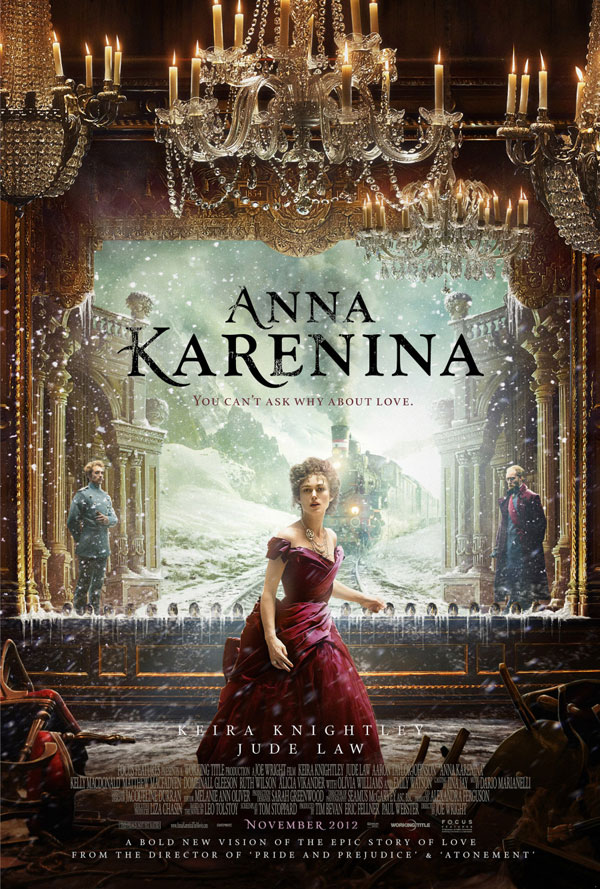
Anna Karenina Joe Wright 2012 movie poster

Joe Wright, the director who gave us “Atonement” and “Pride and Prejudice” tries his hand at one of Leo Tolstoy’s most popular novels and does so by going bold via a new cinematic vision that’s never be done before.

Anna Karenina, the story we all know of the woman who after being tormented by an uncaring husband seeks companionship in a much younger suitor, is given a fresh approach in Joe Wright’s version. The movie has a theatrical aspect that is most definitely quirky. If you are able to get past the weirdness of it, Anna Karenina will prove to be a highly enjoyable movie. If not, then it’s two dreary hours for you.

Keira Knightley gives a great performance as Anna and is definitely helped by the setting the director envisioned for the movie. She brings a ton of sensuality and sexuality to the table, as she has previously done with similar period pieces. Her best scenes, however, are as much a product of her own acting chops as they are of the art direction, camera angles and whole vision. Newcomer Aaron Taylor-Johnson, whom you’ve probably seen before in Kick-Ass and Nowhere Boy, gives a terrific performance as Count Vronsky, Anna’s younger lover. His performance is definitely years older than his young age of 22 and he delivers the right amount of emotion and subtlety that the character requires. Jude Law is almost unrecognizable as Anna’s husband Alexei Karenin. His role, however, borders on the irrelevant at times due to his grossly underdeveloped characters and that’s one of the major flaws in this adaptation.

Joe Wright’s Anna Karenina, while visually enchanting, is flawed when it comes to character development. If you haven’t read the book, Anna’s movie character comes off as a bored housewife whose husband couldn’t satisfy her anymore while, in fact, it was Anna’s husband who drove her to cheat on him but constantly shutting her out. This is not portrayed in the movie. Alexei Karenin is shown as a near saint who can’t understand why his wife would cheat on him and who’s ready to forgive her despite all odds so that by the time the end credits roll, your sympathy towards Anna, the movie’s main protagonist, is next to none.

This adaptation of Anna Karenina is fresh and energetic, risky and ambitious but it’s more about image than it is about content. What Joe Wright did was infuse some sense of modernity into this nineteenth century tale which might get it to connect with a younger demographic that’s not all too willing to read the keystone-sized book. Anna Karenina is one of the most visually inventive movies of the year and despite that taking out some substance, I was still taken away by the world portrayed on screen. However, all in all, the movie is nothing short polarizing, starting with Wright’s new take on the art direction to the way the screenplay was written, culminating in the finished product as a whole. I personally really liked it – but I can see why others would absolutely hate it. Anna Karenina is a movie that seduces you but ultimately fails to break your heart as the ice-cold train wheels break hers.

8/10

Amour [2012] – Review

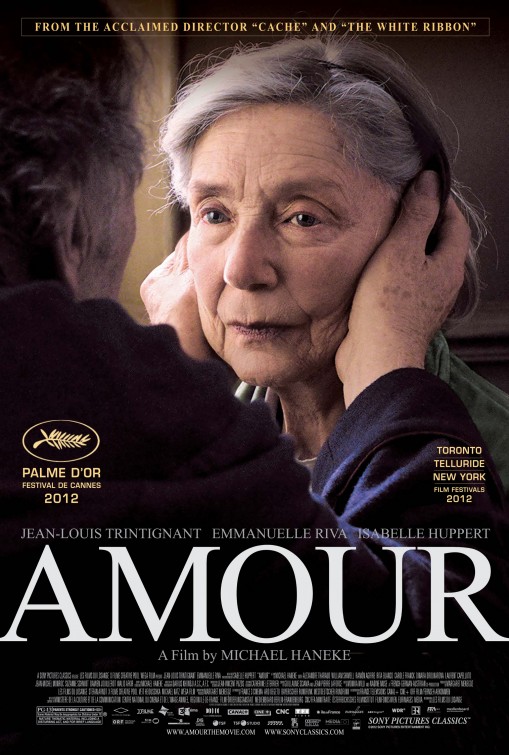
Amour 2012 Movie Poster

In an old Parisian apartment, with its yellowing books, rusty sinks and creaky tables, Georges and his wife Anne, two eighty year old former music teachers live. They go about their lives normally, attending concerts of former students, going through family albums that remind them of their younger days and caring for each other after all the time they’ve spent together. “C’est belle, la vie,” Anne says.

One day, as they’re having breakfast, Anne stops responding to Georges’ talk. He looks into his wife’s eyes and sees nothing there – she remains transfixed, unresponsive, a shell of the woman she was a few minutes earlier. He damps up a towel with water and tries to wipe her face but to no avail. As Georges gathers his things to call an ambulance, his wife comes back – but Anne has had a stroke. A carotid-stent operation going wrong later, Anne needs Georges to take care of her all the time, which he’s more than willing to do. A second stroke leaves her with right side hemiparesis, her right hand curled up in a fist. But Georges keeps taking care of his wife. He brings her a nurse three days a week, tries to sing with her “Sur Le Pont D’Avignon” when she can’t speak anymore, tries to get her to drink water when, in the rare lucid moments she gets later on, the only thing she makes him know she wants is to die.

Boasting beyond brilliant performances by Jean-Louis Trintignant and Emmanuelle Riva as Georges and Anne respectively, Amour is a heartbreaking, stunning and chilling portrayal of life in old age. Georges, the husband giving his all to care his dying wife, reaches a point where he knows what he’s doing is not enough but he keeps going anyway. The husband’s resiliency facing his wife’s forced surrender is a contrast that transcends the confines of the previously described Parisian apartment they both live in, which is the movie’s only setting though never feeling claustrophobic. The clash between the wife who wants to die and the husband who wants nothing but for her to live boasts an intense aspect of humanity that many movies fail to grasp even if they tried to. The nuances in the actors’ performances are striking. The way they look at each other through their wire-rimmed glasses, the adoration that radiates off Anne’s cheeks towards her husband… those are things you come across very rarely and you can’t but appreciate them when you do.

One of the main reasons Amour is this brilliant is Michael Haneke, the Austrian director, who has also written this great screenplay of life, love and death. The visual style he gives the movie is masterful. The pace he sets is poignant, never faltering. The movie he made draws you in, grasps and doesn’t let go. His style is shocking at time such as in Georges’ last act of love towards his wife, a stunning scene that will leave you haunted.

At a certain point in Amour, Georges tries to give Anne water, and she lets it roll angrily down her chin with a look of violent denial of life. Georges unwillingly slaps her, then apologizes like the exasperated caregiver he had become. Later on, he tells her stories of a time when he went to camp he didn’t like. He had agreed with his mother to write her daily. If he had liked his day, he’d draw flowers. If not, he’d draw stars. Amour shows us that life is a mix of flowers and stars. The love this old couple has to each other is the true embodiment of in sickness and in health. Amour is so intimate that watching it feels like you’re prying on these people’s private lives. It is so heartfelt that you can’t but feel touched by what you see. Amour shows you love. And it shows it spectacularly.

10/10

Silver Linings Playbook – Movie Review

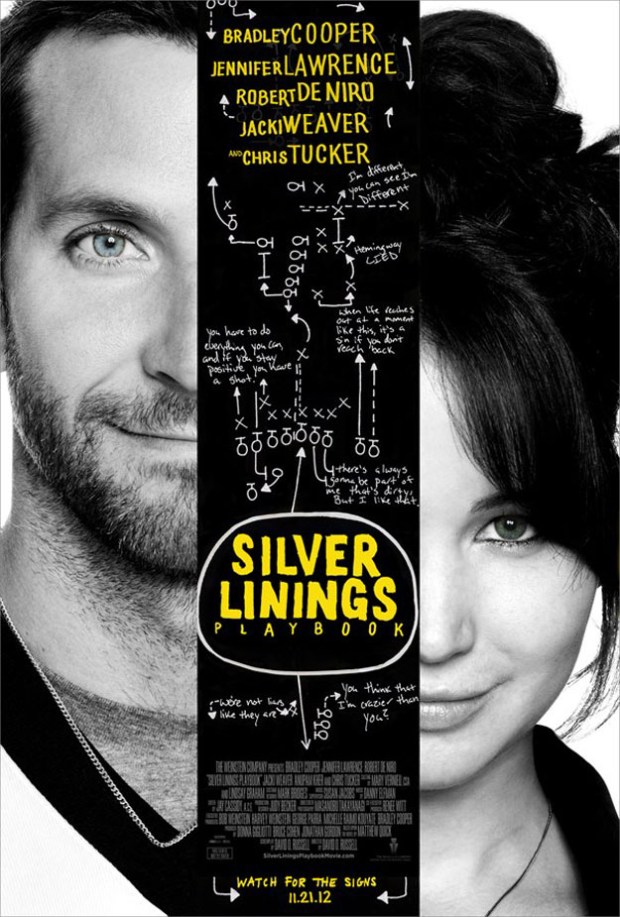
Silver Linings PLaybook movie poster

For all matters and purposes, Silver Linings Playbook is a movie that shouldn’t technically work. It struts the line of a cliche romantic comedy so dangerously close that it could wander into those realms very easily. The premise isn’t groundbreaking. Very little about it is out of the box enough for it to be as brilliantly exhilarating as it turns out to be.

Pat (Bradley Cooper) is a former history teacher who found out his wife was cheating on him and ends up in a mental institute to treat his bipolar disorder, as part of a court deal. Eight months later, his mother (Jacki Weaver) goes on a limb and gets him out. His father (Robert De Niro) is an undiagnosed obsessive compulsive Philadelphia Eagles fan. Set on getting back with his wife who issued a restraining order against him, Pat decides to get his life in order. But the disorder proves harder to control at times. It is then that he meets Tiffany (Jennifer Lawrence), a widow with her fair share of problems. The odd couple strikes a friendship where they feed off each other’s woes and troubles in a brutally honest manner, be it by enumerating the drugs they take without one stutter, by going for jogs around their neighborhoods, by making scenes on Halloween outside a local diner, by Tiffany proposing sex to which Pat objects, by Pat believing Tiffany, the self-proclaimed slut is crazier than him, or by rehearsing to a dance competition that Tiffany wants to participate in.

I was surprised by Bradley Cooper who gives a terrific performance. He portrays the disorder his character is having perfectly. The transfers between episodes of mania and depression is subtle and striking. He delivers his dialogue at a breakneck pace and never falters. His performance is energetic, never subdued, is a true revelation.

On the other hand, Jennifer Lawrence, the movie’s acting highlight, gives a tour de force performance as the deeply troubled widow with layers upon layers of concealed rage to her character. The dysfunctional chemistry she brings to the table is absolutely brilliant to watch. You forget for the entirety of the movie that the woman you’re seeing on screen is only 22. She plays a character way above her age perfectly. She portrays her character’s angst, sadness, grieving and resiliency to perfection. She delivers the movie’s funniest moments in moments that shouldn’t even be funny. In Silver Linings Playbook, Lawrence is simply spectacular and has proven herself to be, yet again, our generation’s most promising new actresses.

The movie’s supporting cast also does well. While Jacki Weaver’s role doesn’t have much character development and is more important in its subtlety as the mother who had to deal with her son’s illness for years and the wife who had to cope with her husband’s obsessive compulsiveness, Robert De Niro gives his best performance in years as the father who cluelessly believes in his son. All in all, the people of Silver Linings Playbook can act and there’s no reason three of them should not see Oscar nominations for what they accomplished here.

David O. Russell, who gave us The Fighter a couple of years ago, has to be commended for maintaing the balance that Silver Linings Playbook shows. His knack for having dialogue-driven movies works well here. However, Silver Linings Playbook is not perfect. The supremely strong first half gives way to a less stellar second half in which the movie loses focus at times as it starts juggling way too many things at once, instead of focusing solely on what was making the movie work in the first place: Pat and Tiffany.

So much could have gone wrong with Silver Linings Playbook. The portrayal of mental illness could have easily turned into a PSA. The romantic part of it could have easily become dreary. The dysfunctional family could have easily turned grating. But all of those don’t happen. Instead, the movie has a sense of rawness mixed with like-ability that makes it oddly refreshing. Silver Linings Playbook is one of my favorite movies of 2012 so far simply because it’s not a color-by-number movie. It is untidy. It’s random. It’s all over the place sometimes. But you still watch it. And you go out of it feeling happy and smiling because Silver Linings Playbook is brilliant.

9/10

My Last Valentine in Beirut – Movie Review

This movie is for serious and smart people only” said the marketing tagline. Then by all accounts, I’m a stupid person who knows nothing of seriousness.

My Last Valentine in Beirut is not a movie. I have no idea what to make of it actually. It’s a horrid mess. It’s a nauseating spectacle. It’s a disgustingly bad atrocity. It’s a jumble of scenes with no apparent link between them except a quest to build up into a running time of approximately 80 minutes. Meet Juliette, a whore in Beirut. Meet a movie director and his assistant wanting to make a movie about Juliette. That’s basically the entirety of My Last Valentine in Beirut for you.

There’s no depth in the movie. Not one bit. The characters are as flat as a board. The storyline – or lack thereof – is so void that you shouldn’t even attempt searching for anything in it. The jabs at Lebanese society are delivered by the characters turning to face the camera – there’s not even one hint of subtlety anywhere. The movie takes cheap shots at other Lebanese movies such as Caramel, Bosta and W Halla2 la Wein which by all accounts are much, much better than this mess. Juliette’s attitude, obviously hyperbolic, becomes more than grating at points. The point of this being a critique of Lebanon today becomes entirely detached from what’s happening on screen that any message the movie tries to pass feels forced especially as the last scene rolls around and you start wondering how the movie got to the conclusion it tries to bring forth with its obvious lack of build up towards anything mentally stimulating.

The absolutely useless 3D is only here for the extra revenue and it’s so distracting at times that it visually hurts. Some camera angles, which are supposedly “artistic,” don’t make sense – even to someone like yours truly whose expertise when it comes to movies is restricted to being an enthusiastic viewer.  Even the only sex scene in the movie is of such catastrophic execution that it becomes one of the movie’s funniest moments. Those are not many.

You’d think that struggling Lebanese cinema would actually bother to come up with good enough movies especially with production being so scarce. But no, you get movies like My Last Valentine in Beirut which keep throwing one crappy scene after another at you in order to break the worst movie in history record, which is a shame really because the premise of a movie discussing prostitution in Lebanon is so dense that this movie, if actually done like a proper movie with a decent script, could have turned out well. Maybe. Who am I kidding. At some point during My Last Valentine in Beirut‘s rather short running time, I wished I was watching Breaking Dawn again. This was one of the worst movie experiences of my life. And that’s not an easy feat at all. My Last Valentine in Beirut has shattered my faith in Lebanese cinema into so many little pieces that next time a non-Nadine Labaki Lebanese movie is released, I’ll rely on other people going on a martyrdom viewing mission before I venture out.

Do not watch this. Even if your life depended on it. Even if your mother’s life depended on it. You could use the $10 admission price in so many better ways, not to mention the time of your life you wouldn’t have wasted trying to watch this cinematic massacre.

1/10 – and I’m being generous. 

My Last Valentine in Beirut To Be Banned?

Leave it to Lebanese movies to reveal inherent complexes among some strata in our society. I have yet to watch My Last Valentine in Beirut and seeing as it’s already been released, I figured it must have passed through the fangs of censorship and landed safely on our screens. But that was too good to last apparently.

No, the problem isn’t with the supposed sex in it. It’s not with the main character being a prostitute. It’s not with the use of “foul” language that might be offensive to some as if people don’t hear the word “sharmou*a” day in day out. The problem with My Last Valentine in Beirut seems to be more clothes-related.

The syndicate of nursing in Lebanon is filing a lawsuit against My Last Valentine in Beirut for using a nurse’s outfit seductively in the movie. The sultry portrayal of nurses in the movie is, according to the syndicate, a violation of the sanctity of their profession. I guess they haven’t played doctor before.

If the demands of the syndicate are met, the movie will be either withdrawn from cinemas or edited to remove these “offensive” scenes. Lebanese filmmakers, regardless of how horrible their movies might be, apparently need to bring in portions from every single part of society for early screenings. You never know what might be in their movies that might be offensive to someone whose mental capacities seem to be limited at best because it seems that lately anyone finds something offensive in absolutely anything and cannot get past it.

You’d think the Lebanese Nursing syndicate would be fighting for the rights of Lebanon’s nurses. You’d think they’d be demanding better wages, better working hours, more benefits. Instead they throw their efforts at My Last Valentine in Beirut because they know that if they make a big enough fuss, someone out there in Lebanon’s narrow-minded censorship bureau will respond. And it’s not like the “sexy nurse” attire in movies hasn’t been overly overdone but feeling empowered only happens when it comes to local productions.

And how about that horrible XXL ad? Doesn’t it have “sexy nurses” for them to sue?

I don’t know if My Last Valentine in Beirut is a good enough movie or not. But I find a request to censor a movie based on what a character wore in it is ridiculous. How silly is it for anyone to find what a character wears in a movie offensive enough to call for the banning or the censoring of said movie? I’m sure even less open countries of the region haven’t had such problems with their productions. And when will people learn that asking to ban anything only brings attention to the thing you want to ban? It happened recently with Tannoura Maxi, which seems to be winning well at international film festivals.

There’s a fine line between fighting for your rights and being absolutely obnoxious. Lebanon’s nursing syndicate is sitting firmly in the nauseating camp. And some wonder where some nurses get their attitude!