Vaccinate Your Children Against Polio Starting Tomorrow

The Lebanese ministry of Public Health is starting a massive polio vaccination campaign tomorrow. As I’m currently rotating in pediatrics, I’ve seen a lot of parents who are unaware of the vaccine, who are having second thoughts about giving it to their children and who have not given the vaccine much thought to begin with.

Why You Should Care:

With the increasing influx of Syrian refugees, Lebanon is at an increased risk of a resurgence of diseases that we thought had long died off in the country, second to successful campaigns, such as polio.
Because the Syrian refugees in the country are uncontrolled, we cannot ascertain the disease load they’re bringing with them as as such we have to be extra careful with our children’s well being.

Poliomyelitis is a viral infection that can leave your kid paralyzed. Why take the risk?

Why You Should Spread The Word:

Polio vaccines are in two forms: an oral form and an inactivated injectable form. Both have 100% efficiency. The latter has no side effects while the former has a side effect that happens at about 1 in 2.4 million. The form that will most probably be employed in the campaign is the oral form and this provides the country with something that is called herd immunity and is actually able to help the children that have not be vaccinated.

How?

Herd immunity is basically the following: when people in a setting are all incapable of catching a disease and therefore spreading it, those who are not vaccinated will be protected by default. In case of the oral polio vaccine, the vaccine gets excreted by the child and can be transferred to other children. Therefore, the more you spread the word and the more children get vaccinated, the more the country will be protected.

Consult Your Pediatrician:

Your doctors are there to help you. Many of you have most probably had their children take the polio vaccine already but if you have any doubt on the matter, consult your pediatrician and ask them what to do. They will be more than helpful given that they are active components of the campaign set forth by the ministry of health.

I know this isn’t the regular stuff you’d expect from this blog but I find this matter of utmost importance and I hope you find that is the case as well.

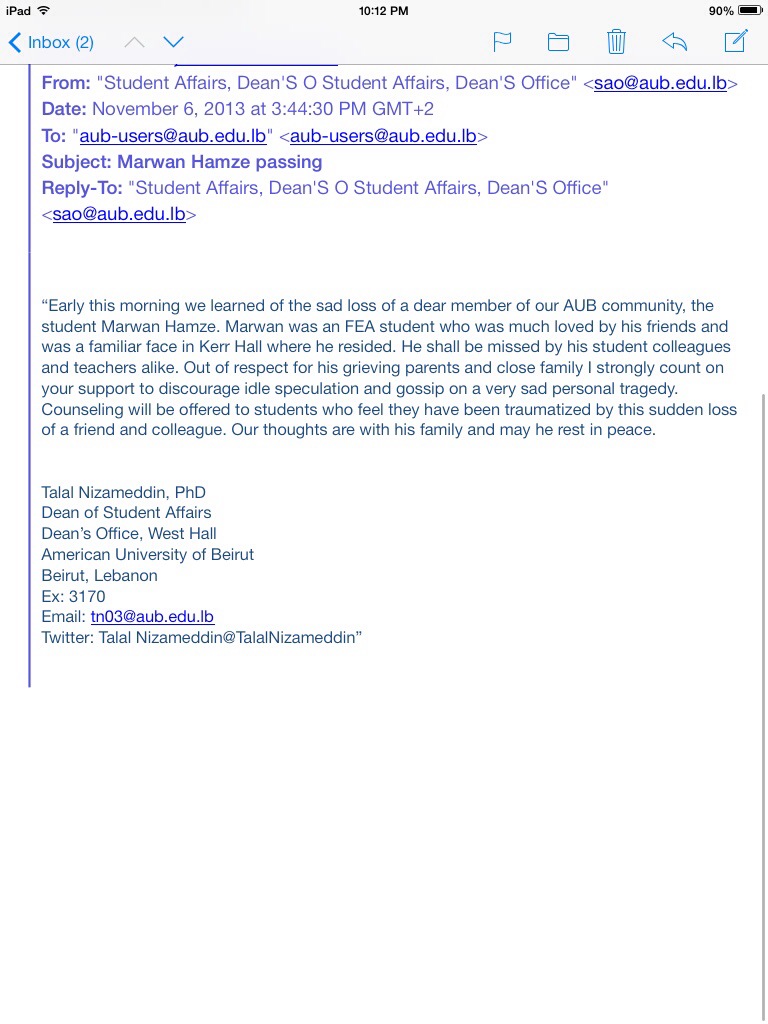
AUB Handles It Excellently: No to Gossip on Marwan Hamzeh

With the news of the passing of an AUB student in mysterious circumstances today, local media was quick to jump on the story with countless theories. It seems they have forgotten that this is person has grieving parents and friends who do not want this story to turn into the media frenzy circus it’s turning into.

No, you do not know enough to say it’s suicide. No, you don’t know enough to say it was politically-motivated. The only thing you know is that this is tragic and that it’s not gossipy material to share over coffee with your friends and journalistic colleagues. If the end a life that happens in such a tragic way is treated like tabloid news, what can you expect when it comes to even more pertinent national issues?

It is here that I have to commend the American University of Beirut for the way they handled this: respect the family, don’t blab. I don’t think I’ve ever seen this from a Lebanese institution.

20131106-221722.jpg

May he rest in peace and may his friends and family find solace in the memories they have of him.

Lebanon Won’t Have Internet Tomorrow?

Picture via Maya Zankoul

Picture via Maya Zankoul

Isn’t this the best news to wake up to?

According to Al Akhbar, Lebanon has failed to pay its dues to the IMEWE internet cable consortium and will be cut off from the country’s main internet supply tomorrow, effectively slashing 60% of our internet capacity. We owe the consortium around $1.9 million. If that amount is not paid by November 3rd, tomorrow, Lebanon will also lose its share of the IMEWE cable which is worth around $60 million.

Given our internet state, slashing 60% off of it means we are rendered with a connection that is barely usable and certainly not enough to sustain the country. Lebanon also has a redundant system which covers 30% of current capacity. Back in July 2012, Lebanon had an outage in the IMEWE cable which was due to technical reasons. We fell back on that failover system and the only functional internet we were able to access was that on our mobile phones.

Who’s to blame for this? Everyone I guess. The Ministry of Telecom is the one in charge of the dealings with the consortium as Ogero has been off the project since 2012. Ogero has notified the ministry back in May about the situation but the governmental situation, or lack thereof, prevented anyone from approaching the issue.

Isn’t it enough that we barely have usable internet in the first place that we now might have to deal with that internet becoming non-existent if not unavailable? Weren’t the many outages of IMEWE a wake-up call to have a decent enough backup system just in case? And why has this news taken so much time in actually becoming known, just one day before the deadline?


The joke currently goes: hit the beach tomorrow and try to get Wi-Fi from Cyprus. Or perhaps we should simply let Qatar handle this, as usual, and then rebrand our IMEWE share to “Shoukran Qatar?”

Bass enno men l aseis ye3ne, la shou l internet? 

Update: According to MTV, the ministry has started the paperwork to pay the IMEWE consortium and keep our connection intact.

So a few questions:
1) Why wait till the absolute last minute and only because the news got this much traction?
2) Is $2 million such a huge amount that we had to reach this pathetic point?

Lebanese Restaurants: What Will Your Price Limit Be?

I decided to go out with a few friends tonight for dinner. Pretty mundane stuff, right? Well, with med schools and all such dinners have become quite rare so I tend to jump on them whenever I can.

We went to a place we were all familiar with: nothing too fancy, supposedly, and prices that were acceptable, supposedly.
We were given the menus. I looked at my go-to item and it seems since I visited that place last back in September, prices had taken a hike.

That same hike also happened last year across many of the country’s restaurants. And then the year before that. And the year before that. And we can go on for several years more but the sentence would become too wordy and tedious.

As we made our way back home, my friends and I wondered: when will Lebanese restaurants realize that it’s unacceptable to have these yearly price hikes that come in like clockwork when there are very few reasons (read none at all) to warrant them?

Lebanese restaurants don’t exist in vacuum. They exist in a country where salaries have not increased since last year and where the economic situation has become very tough for many people who used to frequent such places.

Have they seen their business take a dip over the past year? I doubt. And I doubt they’ll be affected this year as well. But we’re fast reaching the point where burger joints will stamp the word gourmet next to their names and cater only to select clientele because, you know, Lebanese love their exclusivity.

I’m not saying restaurants shouldn’t open a charity-esque business or not work for profit because that defeats the purpose of their existence.  I’m just saying there comes a time when the price of a French fries platter that doesn’t contain that much fries almost hitting $5 is way too much.

The Lebanese Government Doesn’t Want You To Get iPhones

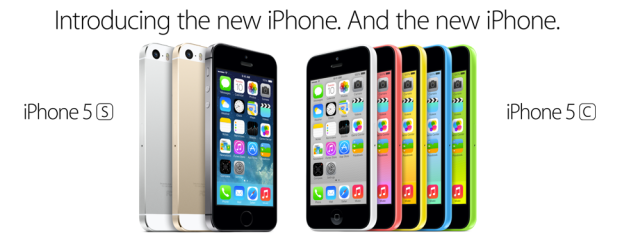
iPhone 5C and 5S

It wasn’t enough for Lebanon’s iPhone users had to deal with the device not being officially released by Apple in the country yet with exorbitant prices and no customer service for their device. Starting in June, regulations have made getting their device into the country harder than ever.

The iPhone 5S and iPhone 5C were released recently around the world to massive customer reception. Their prices in Lebanon, however, are about $1100 for the 16GB version of the iPhone 5S and $720 for the 16GB version of the 5C. To compare, the 16GB version of the iPhone 5S in the United States is $649 whilst the same version of the 5C retails at $549.

Many Lebanese, like yours truly, refuse to succumb to these black market prices and a government which couldn’t give a rat’s ass as long as it’s making enough money for the people running it to remain afloat but still convince everyone that their beloved regulations are in our best interest. Therefore, we buy our devices from abroad and wait for someone to bring them into the country.

Prior to June 2013, that process was as simple as it gets. The phone would come in, we’d unbox it, put it our simcards and we’d be up in running in no time. Today, getting the phone into a state of functionality means getting it registered by a procedure that is retarded but still somehow makes sense for those in governance. Why so? Because they want to take back the millions lost through phone smugglings. How so? By screwing every Lebanese over in the process both bureaucratically and financially.

According to Twitter user Wissam Chidiak, @Fletchergull, the iPhones 5S and 5C don’t get the same treatment that other phones in the market do. Their price tag wasn’t enough, so our government is making it even harder to get an iPhone in Lebanon.

Say you got an iPhone 5S from the United States and wanted to bring it into Lebanon, your passport must not have any other phone registered to it in the past 6 months in order to get the phone working on Lebanese networks. The iPhone 5S or 5C, in order to be registered, take up all 3 phone spots that you are allowed on your passport for a 6 months duration. You won’t be allowed to bring in any other phone to the country if you’ve traveled within that timezone.

Furthermore, the passport being used to get the phone up and running on Lebanese networks must not have entered the country prior to September 24th. The iPhone 5S and 5C were launched on September 20th. Technically, a Lebanese could have had them in the country by the 21st. He wouldn’t have been able to get them registered, however, because that’s what our telecom ministry wants.

Mr. Chidiac has contacted both alfa and Touch, Lebanon’s only telecom operators, who confirmed on separate occasions that the aforementioned regulations are, indeed, true. They were adamant, however, that those regulations are not operator-based and are entirely enforced by the telecom ministry. Chidiac has also tried to contact minister Sehnaoui on Twitter via direct messages, which the minister couldn’t not have read, public mentions of those direct messages which anyone could read. The minister has failed to reply.

You could say that these regulations are in place given that the devices are new and all. But even that argument runs moot with our government because other newer devices do not suffer from the same treatment. Samsung’s Note 3, which was released on September 25th – 5 days after the new iPhones, can be registered with passports that have entered the country prior to the phone’s release. It also takes up only one phone slot out of the three you are allowed. Perhaps our telecom ministry wants to gradually but surely enforce one brand upon the Lebanese population simply due to availability and ease of access?

Our telecom ministry is proud of the advancements that have taken place recently, as is their right, despite some of those achievements having a big “however” plastered all across them – the 4G network comes to mind. At the rate we’re going however, I’m longing for the day when I was able to simply pop in a sim, get it to work then remove it and have my phone “liberated” as is, when my  freedom as a customer to buy whatever I wanted from wherever I wanted, within Lebanese law, was still cherished and not subject to demented, silly and retarded regulations that only serve to inflate the pockets of those benefiting from them. Those regulations, Mr. Sehnaoui, not the 4G network, will be your legacy when you’re a minister of telecom no more.