Now Lebanon Censored… By Saad Hariri

Beirut Spring has just reported that a Now Lebanon article criticizing Saad Hariri and praising Najib Mikati has been pulled offline by the website. You can check out a screenshot of the article here.

If you’re interested in reading it, here’s a transcript (via Qifa Nabki):

The Baby and the Bathwater

If we are to believe a report in al-Joumhouria newspaper on Monday, French President François Hollande and Saudi Arabian King Abdullah, in a meeting also attended by former Lebanese PM and Future Movement leader Saad Hariri, will not back current Lebanese Prime Minister Najib Miqati if a new government is formed.

Do the Lebanese not have a say in any of this? We should worry at the carefree way in which Lebanon’s future is always being decided by outside actors, no matter who they are. The region is already polarized between the Sunni and Shiite communities in a dangerous standoff between Saudi Arabia and Iran. Such horse-trading will only serve to entrench further the sense that foreign powers control Lebanon’s destiny and that each side of the political divide is justified in having its regional backer.

Another worrying aspect was the presence of Hariri, a man who must surely concede that his role in Lebanese political life must now be confined to the margins of Sunni politics. He is living in LaLa Land if he still feels that the Lebanese public would welcome him back with open arms and see him as their salvation. In fact, it would be scandalous if he stood for parliament in the next general elections, let alone offer himself as a candidate for the premiership. (Ditto Nayla Tueni and the rest of the absentee MPs who, by their negligence, have done their best to snuff out the flame that was March 14 and insult the intelligence of the voters who sent them to Najmeh Square).

For it is not enough to simply oppose March 8’s fiendish agenda and make all the right noises about democracy, independence, sovereignty and the sanctity of the state. March 14 members must also take seriously their roles as public servants. The recent deterioration of infrastructure and the apparent collapse of law and order during August have woken up the public to the fact that if they want a functioning, safe, peaceful and prosperous country, and if they want laws enacted, it will not happen if the people they elect to achieve these ends are nowhere to be seen.

Which brings us back to the issue of Miqati and his suitability for the premiership. When he accepted to lead the Hezbollah-dominated government in the spring of 2011, many saw him as an opportunist who would trade what was left of Lebanon’s integrity for a place in the history books.

In reality and with hindsight, he has not done a terrible job. He has advanced the Special Tribunal for Lebanon (despite the Syrian dream of killing the process altogether) and spoken out against Syrian violations of Lebanese territorial integrity.Given the fact that he has had to work with a cabinet of which Hezbollah and its obstructionist allies in the FPM are a part, he has made a decent fist of holding things together.

Hollande and the rest of the international community are right to condemn the current government, which has set new standards in uselessness, but we should avoid throwing the baby out with the bathwater. With the exception of former Prime Minister Fouad Siniora, Miqati is arguably the best candidate we have to lead this country in troubled times.In the meantime, the Lebanese must fight to wrestle their destiny from the hands of those who see Lebanon as a strategic asset instead of a sovereign nation, and all our MPs, without exception, should show up for work.

Saad Hariri, it seems, cannot take criticism. Especially when it’s coupled with praise to his political adversary, which is beyond disgraceful. It seems that Saad Hariri is so worried about his political tenure, all the way from his Parisian lala land (be careful of the cold dear MP, I heard it’s quite chilly this time of year) that he pulled his strings all the way to Lebanon in order to pull the article off a website in which he has influence.

The fact that Saad Hariri cannot take criticism is beyond worrying. It’s also very childish. It’s akin to one of those impertinent children who run to their mothers whenever those “bad kids” on the playground don’t let them play. And this type of behavior is certainly not acceptable from the proclaimed political leader of one of Lebanon’s main parties.

The sad thing though is that this doesn’t only apply to Saad Hariri. Each and every Lebanese politician is off limits by some platform or the other – and what remains, at the end of the day, is an electorate who’s limited by the narrow political opinion it gets from websites that are censored by the politicians it thinks are the best of the best.

And they all run to their mothers crying. They seem to be missing one key element though: good luck silencing the internet.

Update:

The article is back up (here) with the following disclaimer:

Disclaimer: NOW Lebanon has intentionally removed this article from the site. It was not removed because of censorship, but rather because of the lack of proper arguments. We would like to repeat, again, that NOW is not owned, in whole or in part, by Prime Minister Saad Hariri, nor any other political party or figure.

Yeah, right. Such “justifications” are an insult to Now Lebanon’s reader’s intelligence.

Lebanon’s Freedom of Speech & Iran’s Lack Thereof

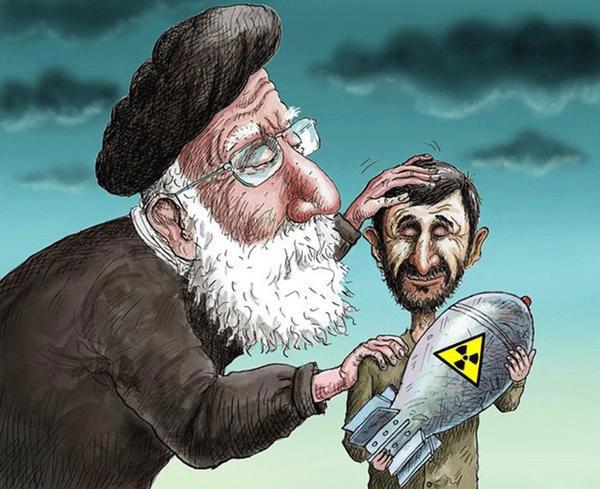
This picture has rubbed the Iranian embassy in Lebanon the wrong way. Apparently, it’s an insult to all Muslims because it’s portraying Ali Khamenei, the Supreme leader of Iran, in a negative way. They also believe that the caricature is in violation of Lebanese law.

It seems the Iranian lack of freedom of speech has seeped into their embassies as well because they fail to understand that just because Khamenei is “holy” to them and possibly a limited number of Lebanese, the rest of the world and of Lebanon absolutely couldn’t care less.

What the Iranian embassy seems to also fail to grasp is that religious figures are not off limits for caricature in Lebanon. How many times has the Maronite Patriach been portrayed as such? How many times has the Sunni Mufti been portrayed in caricatures? How many times has Hassan Nasrallah been drawn in newspapers?

The answer is way too many times for me to even want to research it.

Lebanese newspapers do not approach prophets in their drawings because of journalistic principles. Is Khamenei a prophet? Is he Holier than the prophet Mohammad to have the Iranian embassy panic over him being drawn in a caricature?

The bottom line is: Iran, you have your country and you think things are great over there just the way they are. But keep your insecure paws off of one of the few things keeping me clinging to mine. You are in Lebanon as a diplomatic presence and you’re respected to that extent but it is not in your job description to become a censorship bureau.

God knows we already have too many red lines we can’t cross. We don’t need your red lines added to ours as well.

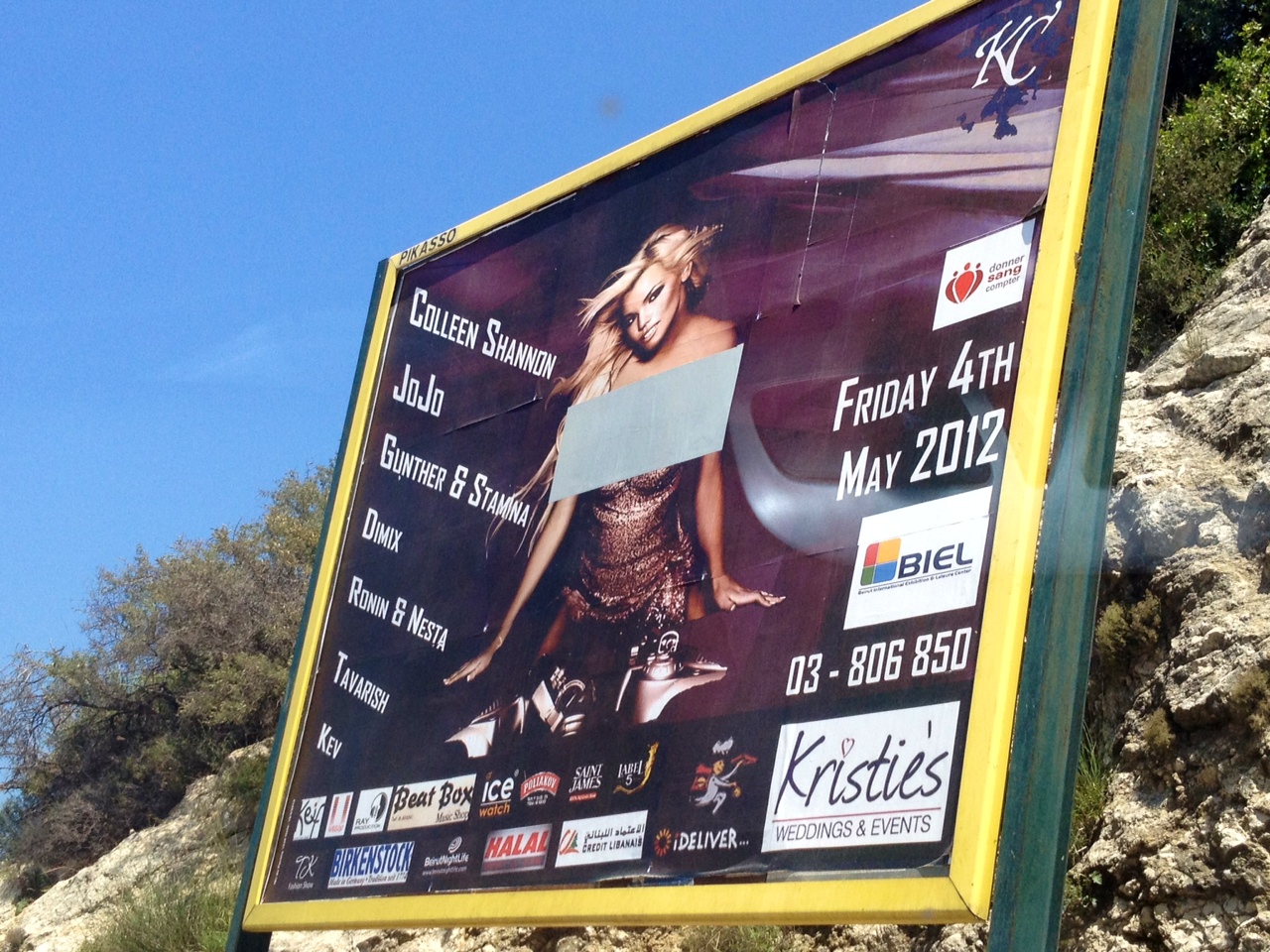
Censored Billboard on Lebanese Highway

I don’t get this at all.

Why would anyone do this to a billboard that they plastered all over the highway?

Do they think it will shift male drivers’ attention from the road? I can think of other ads that do that much better. Shouldn’t they be worried about that alfa-BLOM bank billboard that messes up your vision before you can shift back your focus on driving?

Since when are we a country that’s afraid of showing cleavage in posters? Who allowed such a thing to happen in the first place?

Newsflash: Lebanon is not an uptight and ultra-conservative country.

This is horrifying.

Censorship in Lebanon: Not Exemplary in the Middle East?

The Samir Kassir Foundation recently shared this study that they conducted regarding various forms of censorship in the region. It’s an  interesting read. You can get the PDF here.

What’s interesting to note about the study is that cases of censorship in Lebanon are not among the region’s best. But fear not, it’s not the state that’s actually doing all the censorship.

In Lebanon, two phenomena raised concerns among defenders of liberty. First, the physical assaults on journalists by non-state actors, whether members of political parties, demonstrators, or a new category of activists commonly called “the inhabitants” (Al-Ahali) of some delicate regions. All sides of the Lebanese political spectrum were responsible for such acts.

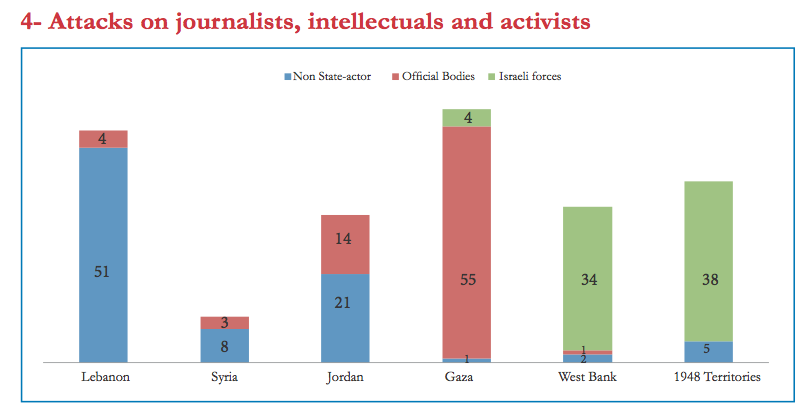
In fact, in the facts & figures part of the study, a graph showing attacks on journalists in each country of the study had the following results:

The low number in Syria is not to be interpreted positively, as the study conductors noted. The attacks, when they’ve taken place, were brutal, as others graphs of the study show: Syria has the highest rate of violence against intellectuals and journalists.

What’s interesting about the results, however, is that 51 out of 55 attacks on journalists in Lebanon weren’t carried out by State authorities, but by non-state entities. Examples given are: Hariri supporters attacking journalists on the “Sunni Day of Anger” when Hariri’s government was toppled, as well as Hezbollah forces attacking journalists investigating their transgressions in Lassa and other villages in South Lebanon.

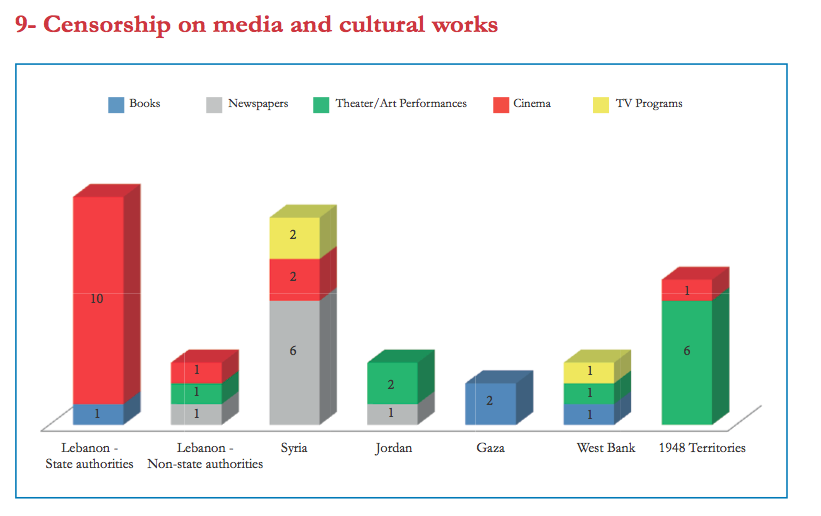
Another interesting fact to note is that the sector most affected by censorship in Lebanon was cinema with more than 10 movies being banned from being screened in Lebanon. Officials justified the decisions as a necessary precaution to preserve Lebanon’s relation with Syria and Iran and our civil peace. I think they were referring to the abysmal Beirut Hotel in one of those points.

For the non-state bans in Lebanon, one is regarding the LMFAO concert ban which happened due to some groups protesting the band’s anti-Christian feel in their song’s video. MEA has banned the newspaper Al Akhbar from being distributed on its flights. And last but not least, the infamous incident to hide Steven Spielberg’s name off the “Tintin” movie poster.

All in all, while Syria takes the cake when it comes to fighting liberties, the situation in Lebanon is not exactly peachy according to this study. Honestly, I didn’t think we had this bad compared to neighboring countries, which leads me to my conclusion.

What I think is a grave flaw in the conduction of this study is that such events in neighboring countries do not make headline news as they do over here, making our numbers seem inflated compared to them. Most of the transgressions that happen in them might be hidden or kept under the radar, making the situation seem much better than it is.

Either way, I’d take the results of this study with a grain of salt. While it is always an interesting read, I don’t think it’s correct nor is it a representative comparison between the countries of the region. Perhaps a look at the numbers of countries known for championing freedom is a clearer comparison. At least you’d know that being skeptical regarding their numbers is unfounded.

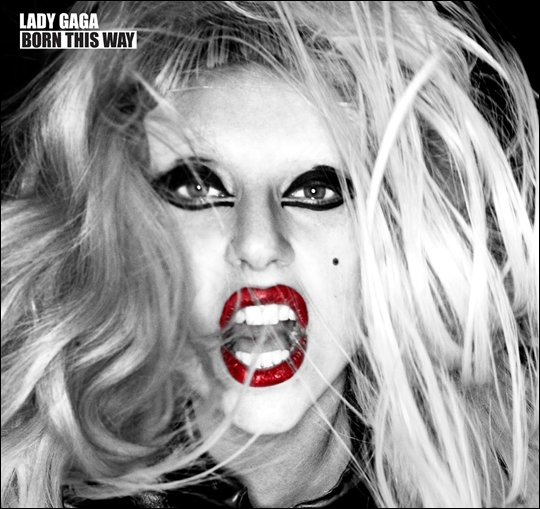
Lady Gaga Unbanned in Lebanon

It looks like our lovely General Security peeps have put their paws up because they were born this way – and that is bipolar.

Mere days after they banned the release of Lady Gaga’s new album, Born This Way, they have revoked their decision and released the album at various Virgin Megastore outlets, the country’s leading music retailer.

While I am all for the decision since I’m against banning the album in the first place, regardless of content, I have to wonder what changed their minds. Could it be the overwhelming pressure from bloggers and social media users? I hardly think so. It might have simply been a case of them looking at the tracklist, seeing the words: Bloody Mary, Black Jesus, Judas and deciding that this is offensive – which is exactly how Lebanese censorship works, by the looks of it: scan the outside, it if doesn’t pass, cut it.

Well, I, for one, am not buying the album simply because I’m not willing to cough up a ridiculous amount of money for it – money that I’d rather spend elsewhere. But for Gaga’s Lebanese “little monsters” as they call themselves, they are already flocking down to Virgin Megastore to buy the singer’s album, as reported by twitter user BilalWH.

And as Lady Gaga would tell her little monsters: just put your paws up, because round one goes to you.