Popsci has recently published, off of a website called PornMD, an aggregation of every country’s porn habits based on the search items users who are located in that country use while accessing some porn websites.
Some interesting observations that the aforementioned website noticed are the following:
Finland has Oedipus complex,
Iran likes to search for gay porn,
Ukraine has a thing for gay raincoats.
Some observations regarding the Middle East that I noticed are the following:
Syria is into some form of incest. Their top search is aunt.
Israelis are into Arabs.
Palestinians love their families even in porn.
Gulf countries have no data involved. Could be all the blocks.
Naturally, I figured I’d look at Lebanon’s part of the info-graphic. It’s sad to say we are not very creative, although slightly nauseating (shit orgy? Really?), in our porn browsing habits:
You can access the entire infographic, which contains no pornographic material, here.
Gino Raidy’s encounter at ZWZ’s Hamra Branch went viral across Lebanon’s internet community very fast. His shock that a restaurant like ZWZ, infamous for his Halloumi bacon sandwiches, would actually have a branch that wouldn’t serve anything non-conformant with Islamic sharia sparked some huge debate as is evident by the extensive response to his post which you can read here.
It is beyond perfectly understandable that such an issue would be considered by many as infringing on their basic freedom of eating whatever they want to eat. It is also beyond ironic that ZWZ Hamra might as well be the go-to restaurant for Lebanese pub-goers who drink themselves away a few meters away in Hamra’s infamous alleyway and other pubs.
So why would Islamic sharia be up and running in one place and completely shattered in another place? ZWZ’s diplomatic reply to the matter alluded to their leasing conditions: the person from whom they got their lease doesn’t allow pork and alcohol on the premises of his building and ZWZ had to conform.
The question, therefore, asks itself: couldn’t have ZWZ opened elsewhere?
The answer is: most probably not.
It’s easy to preach regarding the matter but the fact of the matter remains that landlords have the upper hand in cosmopolitan places like Hamra (despite what Homeland’s producers want you to believe) because of the extremely high demand for property and the low supply. Whatever a landlord wants, a landlord gets. And most companies have to deal with is as such despite their better judgement.
The fix for this is, obviously, stricter governmental regulations. But in a country where such an issue comes at possibly the lowest of importance in woes, such regulations will not be enforced anytime soon.
The issue, though, is not in disassociation with the general mood of the country.
This vigilante sharia applying is unacceptable. I’m not entirely sure if it’s legal as well. Is it allowed for someone to enforce something on their own property that is not legal across Lebanon? My gut tells me no. But Lebanese law has these sporadic eccentricities that make it baffling. And regardless of whether it’s legal or not, what is actually legal in Lebanon and is actually applied?
The only urban planning law that I know of pertaining to this matter is banning alcohol sales within a certain radius of any prayer house, including Churches. Christian areas do not conform with it while places like Tripoli apply it to the letter. You would be lucky to find a place in Tripoli with a carton of booze under the counter which they dispense to their most loyal customers only.
What is sure, however, is that this vigilante sharia is creating an even bigger divide in a country that doesn’t need more divisions to begin with, even among Muslims themselves because it’s not really about religion but about ideology. Banning alcohol and pork, which slowly turns places in a country that falls more on the liberal side in this deeply conservative region, slowly disassociates regions from each other: turning some more extreme while others become more liberal, the cultural and sectarian divide growing even bigger. The conservatives, subsequently, become more conservative. The less conservative folk become less so and the merry goes round. The clash between these ideologies would grow stronger.
Perhaps it is ZWZ’s right not to serve alcohol and pork on some of its premises. But when there’s no regulation to dictate this, the question asks itself: what’s the limit for this sort of “freedom” for restaurants? When does imposing restrictions on others, even those who share your religious views, crosses the line of freedom? And is it truly permissible to say that, due to the presence of alternatives, discussing the presence of Sharia-abiding restaurants should not be allowed?
“I am apprehensive about the situation of the Syrian refugees in Lebanon.”
The aforementioned sentence is enough to get a baggage of racism be thrown on your shoulder by people who believe you are not allowed to address the refugee issue in any way whatsoever unless it is to say they are more than welcome here without anything affixed to that.
The recent surge against all those racist Lebanese comes after an online Annahar video which you can watch here:
The report is very poorly done. Are they seriously filming a ten year old and asking him what he thinks of the Syrian refugees in the country and taking what he said as relevant enough to actually be included?
The way many of the people in the above video formulated their opinion regarding the refugees is unacceptable. But what is also unacceptable is for others to say that the concerns these people tried to convey are 1) racist and 2) invalid. Because, you know, Lebanon is very new to refugees. Those Syrians are obviously the first people we host and their problems are so new we cannot even begin to think dealing with them because of their novelty factor.
It is not only normal to have concerns regarding the refugee situation in Lebanon, it is, in my opinion, the sane thing to do. We cannot keep pretending that 1,000,000 Syrians in the country (Or 300,000 according to UN) is a walk in the park, with no prospective effects and no current effects in any way.
If you mention the Lebanese people who lost their rented homes because their landlords got better offers from Syrians, you are racist. If you mention the jobs that skillful Syrian physicians, accountants, architects and whatnot took out of Lebanese people, you are racist. The list goes on. It is obviously not the Syrians’ fault but it is an effect that some people don’t want to allow us to discuss. Because racism, racism everywhere.
When does this categorization of Lebanese who are critical of the current situation stop?
On the other hand, the categorization against the Syrians is unacceptable as well. Our country’s problems are not dependent on them and them alone. Not feeling safe while walking on a street is not because of the Syrians but because Lebanon is not a safe country with or without them. You can read this story that a friend of mine had to go through while walking in Gemmayze (link). The economical situation in the country is less the fault of the refugees and more the fault of politicians who are perpetuating the current political instability.
The borders should not and will not be closed for they are non existent and it would be grossly inhumane. The Syrians don’t want to come here. They are forced to come here. There is no way to regulate their influx as I had said before (link). They are here knocking at our doors with a riffle in their backs. If we don’t let them in, they get shot. There is no Syrian civilian entry to Lebanon that is not an emergency. The only thing that we, as Lebanese, can do regarding the refugees is have discussions.
The Syrians hosted some of our people in 2006. Of course they did. And we are thankful. But them hosting us back then is akin to a billionaire giving a poor person $100 and asking him to be eternally grateful for that. They were able to handle the thousands of Lebanese that entered their territory for a period of about three weeks.
Lebanon, a country that can’t even handle someone like Ahmad el Assir or even the poverty of people in places like Bab el Tebbane and Akkar and the South, cannot handle one million extra person who need help.
It is a Lebanese’s right to be wary and worried and apprehensive. The way that worried Lebanese formulates his or her worry and apprehension may differ and it may be unacceptable but those who don’t feel this way are similar to an ostrich with its head so far down the sand it can’t even manage to get it out anymore.
The conclave of Cardinals in charge of electing the new pope to replace Benedict XVI is currently underway at the Sistine chapel in the Vatican. You’re out of luck if you are a Roman tourist at this time of year – you can blame Benedict’s old age for that.
As it is with papal elections, there is no clear frontrunner as of this point. The myth goes that the cardinals leave their choice to the holy spirit through copious amounts of prayers and holiness. That is if you believe the holy spirit is a combination of politics, geographic, demographics and whatnot.
Eventually, any Pope nowadays is chosen based on one premise only: strengthening the position of the Catholic Church around the world. The late pope John Paul II led one of the biggest developments the Catholic Church had seen when it comes to the Youth, especially in popularity. Benedict’s undeclared job was to contain this surge that John Paul caused in a more Christian, usable, framework.
Today, the Catholic church is stuck at the edge of a steep cliff with the following predicaments:
Decreasing worshippers across the world,
Rise in Christian persecution in certain parts of the world,
Sex-related scandals that plague Catholic priests more often than none,
Corruption scandals that always seem to find a foothold,
The issues of abortion, same-sex marriage and other thorny issues.
Seeing as the Catholic church is firm in its position regarding abortion, same-sex marriages (despite some recent breakthroughs in that regard), stem cell research and the like, I believe point #5 is not even an option in the voters’ mindset. Corruption and sex-related scandals are issues that Cardinals feel should be best kept in-house, not influencing the decision of choosing a Pope who will lead a Church not only based on those two criteria. The stances of the Catholic church regarding the many sex abuse cases that were revealed is a testament to that – if anything, it reminds me of typical elderly Lebanese women whose job in life is to cover up any wrongdoing in their family and showcase it to the world in positive light. Cardinals are similar to those elderly women in that regard.
The most important framework for Cardinals voting today is the following: help Christians around the world stay Christians and lessen the numbers of Christians who are deciding not to be so anymore. There’s little that a Pope can do when it comes to decreasing worshippers – after all, how do you convince people who lack faith that they should have it? It’s impossible. But what the papal conclave of Cardinals can affect is the persecution of Christian minorities across the world, notably in the Middle East.
Pope Benedict’s XVI’s visit to Lebanon back in September – his last major visit to any country before his resignation – was not out of the blue. Him demanding Patriarch Raï to go to Syria and hold mass there, which sparked an insane reaction, was also not out of the blue. Small steps they may be, sure, but for the faithful who still cling to their belief despite the hardships, a patriarch or a Pope acknowledging their strife is some very important business.
The question, therefore, asks itself: Could Patriarch Raï be the dark horse to be elected as the upcoming Pope?
Many Lebanese have already set Facebook pages to that effect, out of enthusiasm mostly, as if a liking a Facebook page to demand our patriarch be instated as Pope is actually beneficial or worth it. But that’s how things are with us – we always take things to Facebook.
However, I have thought about it lately and come to conclude that Mr. Raï could have a decent, albeit slight chance, at becoming the world’s next Pope for the following reasons:
If the main focus is to target the persecution of Christians in the world, what better option than the head of the Christian majority in the location where Christians are targeted the most? The Middle East.
Former pope Benedict’s XVI’s visit to Lebanon was, in part, to sign the Post-Synodal Apostolic Exhortation (text) in which the Vatican goes on and on about the crucial importance of the Church in the Middle East.
A Pope from the Middle East would set the wheels for true Muslim-Christian dialogue, which is what this deeply religious and troubled region needs and the Vatican knows this.
Patriarch Raï is age appropriate to be pope. He is only 73. He also speaks several languages fluently, as is required of Lebanese bishops.
Patriarch Raï does not come from a country where priest sex scandals are aplenty and being relatively unknown to the vote has a rather “cleaner” slate than his counterparts. He was also elected as an assistant to the interim Pope over the past week.
The reasons may not be supremely compelling to have someone become Pope, sure. But they’re still viable enough to put Mr. Raï on the papal map. I’m not even sure if Mr. Raï can be a good pope but he might become one. And frankly, him getting elected sort of scares me.
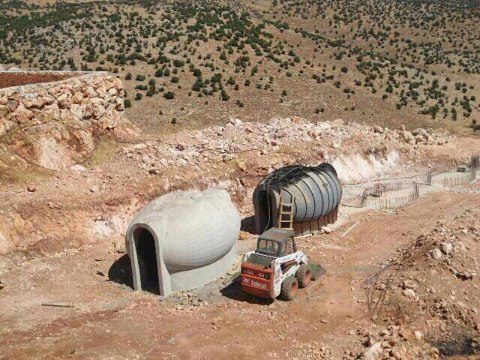
We are welcoming a new “biggest” achievement in the circle of things no one else in the world has beaten us to. The Bekaai, Becharre-wannabe, town of Deir El Ahmar is building the world’s “biggest rosary.” Construction is already underway:
(Source: Lebanese Forces Facebook page)
Biggest rosary, biggest cross, biggest cup of lemonade, biggest dish of hummus, biggest dish of tabboule, biggest house made up of matchsticks, biggest collection of matchbox cars… the list goes on. But the question to be asked: when does the “biggest” mania stop?
Are we compensating for something that’s lacking? And for those whose mind wandered, get it out of the gutter. I didn’t mean that – I meant the lack of accomplishments to which “biggest” can apply and which are actually useful.
Instead of building the world’s largest rosary, couldn’t the money have gone into something that would actually benefit the people of Deir el Ahmar in more tangible ways? Say a business project that would give them jobs?
“Ra7 tdall jrasna tde2,” (our church bells will keep ringing) was some people’s comments regarding the rosary. “Ne7na hon,” (we are here) was their comment regarding the biggest cross. “Beddna n3e22,” (we want to binge drink) could have been the slogan for the biggest lemonade cup that my district’s main city Batroun did.
But what remains constant is that few are those who know that “l jras betdall tde2″ not only through humoungous rosaries. I can only say do one thing regarding all of this: sigh.



 A Separate State of Mind | A Blog by Elie Fares