
Crepaway Taking Steps Backwards

I was overly happy when the Batroun branch of Crepaway made a separate non-smoking area for those of us who don’t like to inhale with their burgers.
However, as I visited the place with friends, I found the area filled with people who were smoking. I asked about it and was told that they had removed the non-smoking area for the day. The explanation? they didn’t want the smokers to be placed on a waiting list for the smoking areas.

Excuse me Crepaway if I wanted to dine without the smell of cigarettes and without that awful stench getting stuck on my clothes and lungs. I mean, the emphysema I am most certainly going to acquire in this country cannot really be compared to the ten minutes of wait that a smoker has to endure, right?

In Lebanon, non smokers are figuratively run over by their overly dominant opposites in society. After all, clean air is something you’re not entitled to in a country where finding hookahs in American style diners is very common and even normal and where non-smokers have become a distant minority, squashed in almost rodent-like manner.

And let’s talk about the pricing! Back in December, the natural counterpart for Crepaway in Lebanon, Roadster diner, boosted its prices by a considerable amount, causing my friends and I to lessen our visits to a place that was eating away more and more an already tight budget. In the meantime, Crepaway boosted its prices in a lighter manner and they remained quite acceptable for what was offered.

However, I was surprised during my visit to Crepaway that they had increased their prices yet again. The famous Spielmozzarella is now priced at about 17,000LBP, about $11.33 and a Chicken Escalope platter is almost 20,000LBP (about $13.33), with smaller portions of French fries and coleslaw.

I understand fuel prices are on the rise in the country but I am positive chicken is not getting more expensive and nor is meat and, well, I am not going to a restaurant to dine on 95 Octane fuel while sniffing on the “exquisite” scent of a Marlboro.

AUB Purposefully Losing Its Identity

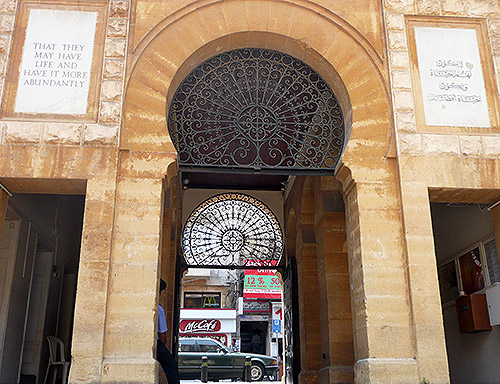
Whenever you recite the following Bible verse: “that they may have life and have it abundantly” in Lebanon, the first thing that comes to a person’s mind is the country’s most prestigious educational facility: the American University Of Beirut.

The moment you walk into AUB’s campus, you are striken by how different it is from the city in which it is found. It’s a piece of land inside Beirut where buildings are, unlike their Beiruti counterparts, being preserved, where trees grow freely (and where cats roam without being disturbed). College Hall, the building that first welcomes you when you enter through AUB’s Main Gate was totally destroyed in a bombing that targeted it in the 1990s. However, the university rebuilt it exactly as it was. AUB was an example of cherishing legacy in a country that is running away from its past as fast as it could do so.

Next to College Hall is a building that looks like a chapel. It has the Protestant architecture of a chapel. It even has an Organ inside. And to make its original purpose even less inconspicuous, it has a Cross on its roof. However, what used to be a church was transformed into what is today AUB’s Assembly Hall – a place where students gather for commencement, concerts, etc…

The change that “Assembly Hall” faced was considered as the ultimate change in the face of AUB, previously known as the Syrian Protestant College, which was founded in 1866 by American missionaries Daniel Bliss and Henry Jesup.

AUB today is a secular campus in a country that is striving to attain a secular situation. It is a place where people from all sects and religions can attend and expect to obtain the best level of education that Lebanon has to offer – and that is a great amount. However, no one expected the decision taken by the AUB administration to change the university’s most famous slogan into one that does not have any religious affiliation.

Yes, the verse “that they may have life and have it more abundantly” will apparently be changed into some other phrase, as part of the university’s new marketing campaign – to “better the university image”.

The questions beg themselves. Does the AUB administration think the current reputation AUB has cannot withstand the fact that its founders chose a very poignant Bible verse to anoint the university with? Do they really think AUB benefits from anything that takes away of its 150 years of history, let alone a meaningless campaign to attract more students, one that will be forgotten in a few months? And do they really think that the current AUB image is improved by changing the verse that is written on its Main Gate as a way to tell all the ultimate purpose of attending the university?

AUB is slowly eating away at what makes it a special beacon in Lebanon and the Middle East. AUB used to be a revolutionary facility where scholastic evolution merged with a sense of historical belonging. It looks like the strings of this sense of belonging are being slowly chipped away by the lure of more dollars flowing in to an already overflown treasury.

You’d think what has already taken place at AUB regarding the separation of religion from the university is enough. The steps taking place today can be described as a form of administrative theophobia.

The improvement of AUB’s image does not start by removing the phrase that would make any AUB student proud to hear. It starts by improving the university programs to a point where they can compete better with universities abroad. It starts with giving us better labs, where we can stretch our wings a little outside the tiny boxes in which we are bound by professors whose knowledge in their courses has been hampered by their sense of megalomania and it starts by getting down from the high-horse this administration has fabricated around itself and realizing that, if AUB continues on the path it’s on, the only way to go is down.

Driving in Lebanon

It’s no wonder Lebanon has the highest amount of “credible” psychics in the world. It’s a simple manifestation of Darwin’s theory of natural selection. How so? Let me elaborate.

When you drive in Lebanon, you need to have a sixth sense in order to survive – a sense that lets you anticipate what the other drivers around you decide to do so you react accordingly.

What’s the point of using blinkers to signal going left or right? just swerve out of the left lane to go into an alley that branches out of the right lane, which happens to be three lanes away. And you know other drivers aren’t bothered by this because, well, they probably knew you were going to do it.

Continue reading

The Lebanese Civil War Synthesis

April 13th marks the anniversary of the Lebanese Civil War.

On this day, most Lebanese repeat the phrase: “let it be remembered but not repeated”.

As part of my understanding of that phrase, I decided to write up one one of the civil war incidents that touched my family deeply. My uncle was shot and his cousin killed on the same day, April 2nd.

I wrote the story in three parts. And I hoped that they would show what one Lebanese family went through on one one day of the war that lasted for over 15 years. I did not mention extra details about the political parties involved in my story: who was bombing, who was defending… because I wanted to show the Civil War as not a period where some people were right and others were wrong. It’s a period where the Lebanese person, as a whole, got hurt, deeply. It’s a period where Lebanese families were torn and the country was ruined – regardless of religion and sect and political affiliation. You can read the story here: part 1, part 2 and part 3.

Today marks the 36th anniversary for the civil war, which started on April 13th 1975 with the Ain Remmaneh Bus incident. Some people actually believe the bus incident was the main cause for the war. But that is not true. If anything that incident was only the face of a much deeper divide on a country that praises itself for its richness and diversity.

I have not lived through the civil war. So my personal understanding of whatever took place is rather limited. Nor do I want to know too much because well, it is time that we, as a society, move forward from the wounds caused by that era.

Continue reading

Lebanese Civil War Stories – Part 3

Continued from Part 2.

Saint George’s Hospital was packed. Simon’s mom looked at the multitude of strangers in front of her. They were all in agony. The mothers that had lost sons, the wives that had lost husbands…

She was asked to come down to the hospital. She didn’t know why but she felt it was odd that her sons hadn’t come back home yet. But for all she knew, they were hiding out at some relative’s house.

On her way there, she had heard how her brother-in-law’s son, my uncle John, was hit and taken to the Geitawi hospital. She knew his condition wasn’t severe. But why was she in Saint George’s hospital?

She looked around. Strangers. There wasn’t any face she recognized. And somehow, she couldn’t even connect to their pain. So she sat there, in the waiting room, waiting for God knows what.

But then she noticed the whispers. Why were the people there looking at her through sad eyes, breathing out worried words she couldn’t comprehend with their tired mouths.

And suddenly she felt there was something she didn’t know. And she started to get worried. Her sons hadn’t gotten home. Her oldest son, George, had gone to get his sister from school. Her son Simon had supposedly also gone to do the same thing.

Why weren’t they back yet? They should have been back when she left the house. Something must have happened to them…

And like every concerned mother, her train of thought took her from being in a relatively comfortable state to a mental wreck.

One of the doctors ran in front of her. She stood up and shouted “take me to your morgue”.

The doctor stopped in his tracks. He turned around and looked at her. “My sons are in your morgue. I need to see my sons”.

Continue reading