Saad Hariri and Twitter: A Story Filled With Mistakes

When Saad Hariri first went on Twitter, many were hoping he’d use the platform productively to enhance his political career, which has been sitting on the back burner for the past few months as he globe-trotted his away around everywhere except Lebanon.

But a series of mistakes, the last two of which are only a few of days apart, have gotten many – myself included – to wonder whether it was really wise for Mr. Hariri to join the social networking platform.

In January, Hariri said good morning to an Israeli government spokesperson. Either he didn’t know who that person is or he knew and still said good morning, which in both cases is worrying: the former because it shows a certain political ignorance; the latter because it would open a Pandora’s box that Lebanon is obviously not ready for.

On May 10th, Hariri got into a useless Twitter debacle with a brainwashed pro-FPM twitter user who has been constantly barraging him. The aim of the anti-Hariri person was clear: to provoke the former prime minister. Hariri caved in. However, instead of replying in a way that a former prime minster should, Hariri’s reply was straight out of a teenager’s handbook. Of course, Tayyar.org were more than happy to flaunt this around, useless as they may be as a news-website.

On May 13th, soon after the Tripoli events erupted, a Twitter user had the following conversation with Saad Hariri:
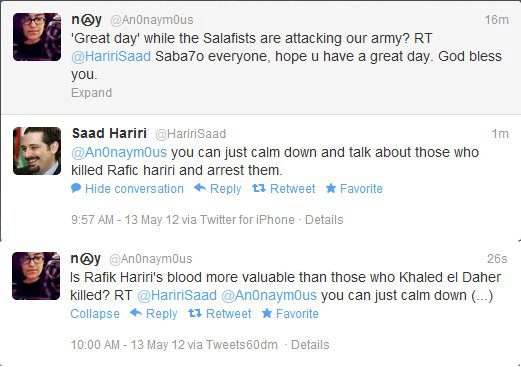
Not only is Mr. Hariri’s argument non-sensical, but it’s also offensive to every single Lebanese who has been killed or assassinated before his father and after him. I wrote on February 14th about how the memory of that day is being milked into nothingness. This only supports my idea.

Does Rafic Hariri’s murder have anything to do with the events taking place in Tripoli? Absolutely not. Is it honorable to bring in Rafic Hariri’s memory – regardless of what you thought of him – into this debate? Of course not. Does it make up a remotely acceptable argument or reply? Definitely not.

I know many people who are disappointed by the way Hariri is handling things on the ground and more tangibly on Twitter. This only serves to reinforce that. Some have even said they’ve lost their respect for the man. While I haven’t reached that extent yet, Saad Hariri is getting dangerously close. Whenever he pretends as if Rafic Hariri is the only person to be assassinated in Lebanon, I boil on the inside. I think about the many people who have died before him, starting with presidents to students, and the many journalists and politicians that died after him, leading up to the many that lost their lives in various Tripoli-related events, culminating in today’s turmoils. Then I ask myself: if a politician thinks the blood of his father is more precious than the collective of lives that have been lost in the same fight his father died for, how can I trust such a politician to run my country? How can I trust him to keep a level-head, even if it’s just a twitter conversation?

I believe Mr. Hariri’s stay outside the country has gotten very out of sync with Lebanon and it shows on Twitter not only through his replies but through his stances. Tripoli is a city where Hariri has many voters, most of whom he will need in a year to win, and he is supporting the people who are wrecking the city just to free up one man. By not condemning the salafists, the head of the moderate Sunni party in Lebanon is supporting them. If that’s not a recipe for disaster, I don’t know what is.

Perhaps Hariri should hire a PR team to run his social media presence. It would save both himself and his supporters some trouble by doing what other Lebanese politicians do. However, if he insits he wants to keep his interaction with the people going he needs to learn to double check any response he sends out on various levels: political correctness, appropriateness and most importantly whether it befits someone of his status.

Why I’m Against Proportional Representation (Nesbiyé) in Lebanon’s 2013 Elections

One of the main debates going on in the country currently is regarding the 2013 electoral law, mainly whether to include proportional representation in it or not.

Politicians’ views are already diverging on the matter and they break down to the following:

– Walid Jumblat: Against. He wouldn’t be totally dominant over the Druze vote and would lose a decent amount of his influence.

– Saad Hariri: Against. While he’s not as affected by this representation-wise as Jumblat, his stance has varied from being supportive of proportional representation to against it solely because he wants to bring Jumblat to his side for the elections.

– Hezbollah: With. They get about 90% of the Shiite votes in elections, which is where they have candidates. 90% in the proportional representation law would give them all the seats with very minimal effect. It’s a win-win situation for them so why not demand Lebanon as one district with proportional representation to have bigger gains across the map?

– Michel Aoun: With. Why wouldn’t he approve of something that would make him benefit from all the votes of the party mentioned above?

– Samir Geagea: No idea. He has made arguments than can go both ways so his stance regarding this matter hasn’t been fully formulated yet.

One of my main problems with proportional representation is that it is thought of as the cure to our system when it is far from being the case. Many believe that applying “nesbiyé” in the 2013 elections will start decreasing sectarianism by having different people from certain sects getting representation.

In order to do that, the electoral districts being thought of are getting increasingly bigger. Some are even suggesting to make Lebanon one whole electoral district. The argument? This is the only political elections where the population gets to vote so why not get the whole country to vote for everyone?

The way I see it an MP is a representative of their corresponding region first and foremost. Increasing electoral districts to make “nesbiyé” work will not lead to better representation. Or is it “representation” only when certain parties that wouldn’t dream of a parliament seat get one even if they don’t represent the woes of a region? Does a citizen from Beirut know what are my concerns as a citizen from Batroun? I don’t think so. Do I know what are the concerns of my friend in the South? Absolutely not.

What gives me the right to choose their MP and them mine? The sake of national unity? Please.

And for those who believe districts should be medium-sized, say according to the mohafaza – what do people in Batroun know about what a caza like Koura needs? What do people in Zgharta know about the demands of people in Bsharre?

When during parliamentary sessions an MP talks about his district as his main focus, you know this is what they represent not the whole country as we so gullibly want to believe. And it is definitely their right. The whole idea that we, as a country, need everyone to vote for everyone in order to reach unity is non-sensical. You don’t see it happening anywhere else in the world that a country votes for all the MPs its parliament has.

Let’s talk about how practical applying nesbiyé would be. I, in Batroun, get 2 MPs. In the 2009 elections, the margin for those who won was 53%-47%, which in a nesbiyé-equipped scenario means that the result wouldn’t be 2-0 but 1-1. Is that a representation of the will of the caza? Definitely not. Of course, applying proportional representation means Batroun would be merged with other districts, which brings me back to the point I mentioned previously. In reality, most cazas don’t have an overflow of MPs they get to vote to.

It is here that I have to ask: what’s the point of people voting and giving someone a majority when everyone gets to power either way? When I vote for someone and against another person, that means I do not want that person to represent me. If the results of my district turn out to be in my favor and the person who lost ends up in office anyway, then what’s the whole point of elections to begin with?

Moreover, in the current state Lebanon is finding itself today, especially with armed parties swaying the balance of power, would nesbiyé truly be fair, as it’s alluded to be, for parties that don’t have weapons?

In the current form of sectarian Lebanon today, when all sects except Christians give a majority that cannot be contested to one specific party, wouldn’t proportional representation with bigger districts dilute the Christian vote to a point of irrelevance as we’ve seen, for instance, in the 2000 and 2005 elections in certain districts?

In a country where division is based on sects and regions, any law will be accused of increasing either tension. The 2009 law is blamed for increasing sectarianism. We say that because we love to hide and pretend as if our regions are not a mass aggregation of people from one specific sect when, in fact, the only reason we look at the 2009 law negatively is because the results it brought about was a collection of people who couldn’t rule to begin with and others who don’t know how to rule.

Just take a look at a map of Lebanon and you’ll see exactly how one-colored most regions are. This is a demographically situation, not an electoral one.

No, proportional representation is not bad, as some politicians are saying, because it increases Syrian influence in Lebanon. Proportional representation is bad because it’s so ill-timed it is nowhere near the solution it is made out to be. It can only possibly work with bigger circumscriptions, and everything aside, this is an inherent flaw that cannot be ignored. It can only work when the political system of the country is not a disproportionate sectarian representation to begin with. It can only work when the main parties that will make part of it have, at least, some varying degrees of equal influence. When not everyone is fundamentally on equal footing, you can’t have a law that equalizes them in voting booths.

The Truth Behind Boutros Harb “Bowing” To Feltman

The following picture spread around like wildfire these past couple of days. Those against Boutros Harb started going on about how he was going back to his “roots” of bowing to those who are “superior.” (Yes, I have heard this being said.). Those that support him figured it can’t be true. I am neither a blind supporter nor a hater, so I simply didn’t care.

Typical Lebanese positions.

But there’s a video now to show which side was right. It looks like the picture was a very cheap shot by Assafir. They knew what he was doing and still published it anyway.

Feeling Concerned in Lebanon About The French Elections? You Shouldn’t? Well, Why Not?

The French presidential debate between Hollande and Sarkozy took place yesterday and it was closely watched by many Lebanese enthusiasts who are interested in French and international politics.

As those Lebanese watched the three hour debate, myself included, others were saying all over social networks how “we were not concerned” with this, how we should “scan our French passport” with every tweet or Facebook status we updated and how we really have nothing to do with French politics to begin with. “Ktir 3eyshina, wlo!”

Those people asking us not to feel concerned are the almost the same group that preach about how Lebanon is a playground for superpowers and that we, as people, need to stop following either political sides of the country because one is a pawn for Iran-Syria while the other is a pawn for the United States-France-KSA.

How could you ask us not to feel concerned when you are willingly admitting that France has a substantial influence in Lebanon?

The way I see it, because Lebanon is a playground of superpowers, not feeling concerned is the incorrect way of handling things. But I wouldn’t judge you if you decided you didn’t want to be involved. Therefore, I would also like from you to extend me the courtesy and not make it seem like I’m a blinded g0-after-they-hype Lebanese.

I can’t vote? So what? Does that mean I don’t get to have an opinion that I can express? This whole mentality of us – Lebanese – not having a political horizon extending beyond the 10452km2 of our country needs to be abolished. Sometimes, foreign politics is way more interesting – and civilized.

How so? Well, watching these types of debates can only lead you to have a better understanding on how political life needs to be done in Lebanon. Did you notice how Sarkozy and Hollande, despite being subtly at each other’s throats, were very polite in dealing with each other? Did you notice how, after the debate ended, they both had had the exact same talk time?

Where do we see this here? Or don’t you remember the incidence when Moustafa Alloush and Fayez Shukr almost slit each other’s throats on national TV? Or how about Alain Aoun and Ahmad Fatfat during the most recent parliamentary sessions?

You don’t think French politics concerns you? Fine. Don’t take it out on those who disagree with you. A word of advice though, I’d stay clear out of social networks when the American elections roll around. If you thought we were too much with the French elections, the American one will be a bloodbath, figuratively of course.

Nicolas Sarkozy & Barack Obama’s Presidential Campaigns – Who’s Copying Who?

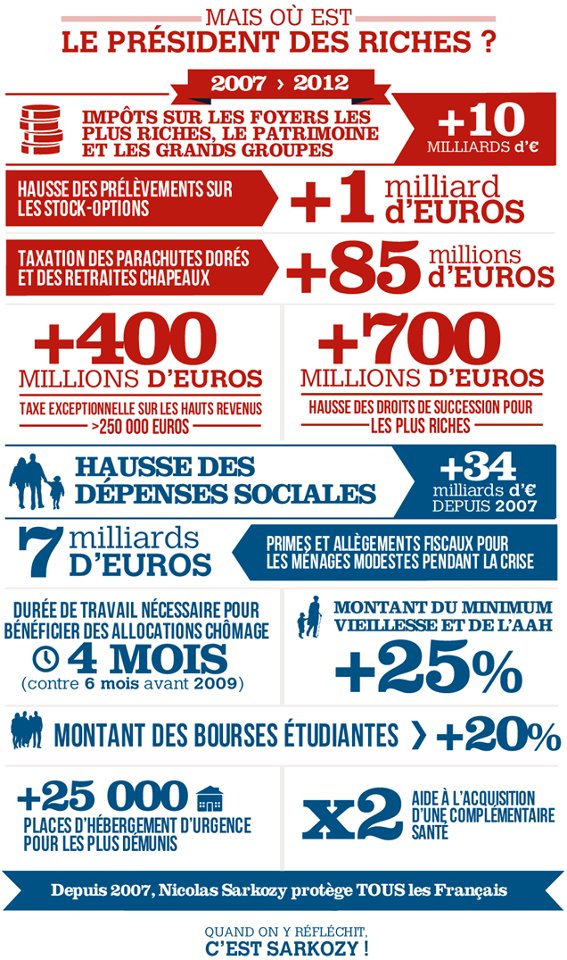
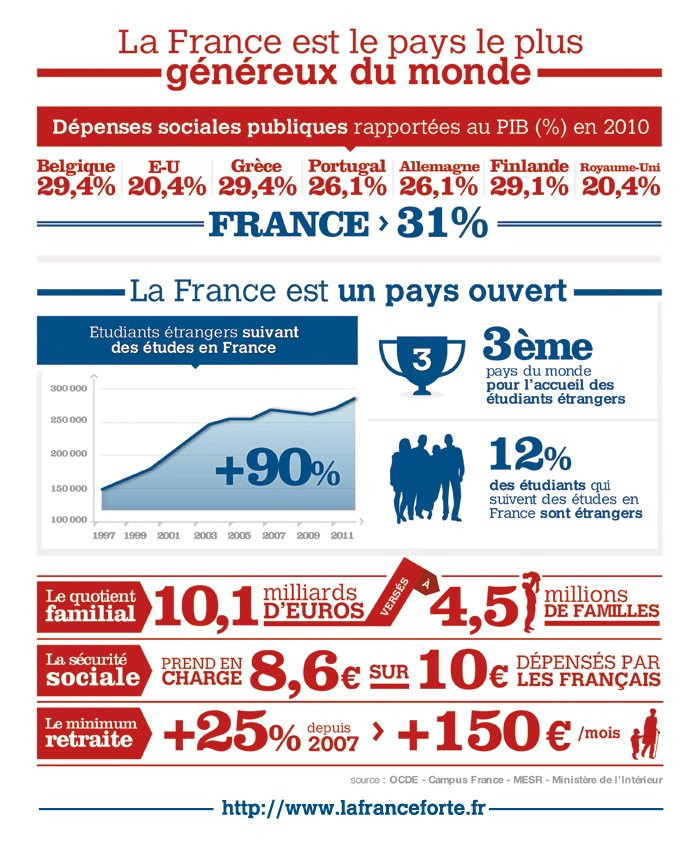
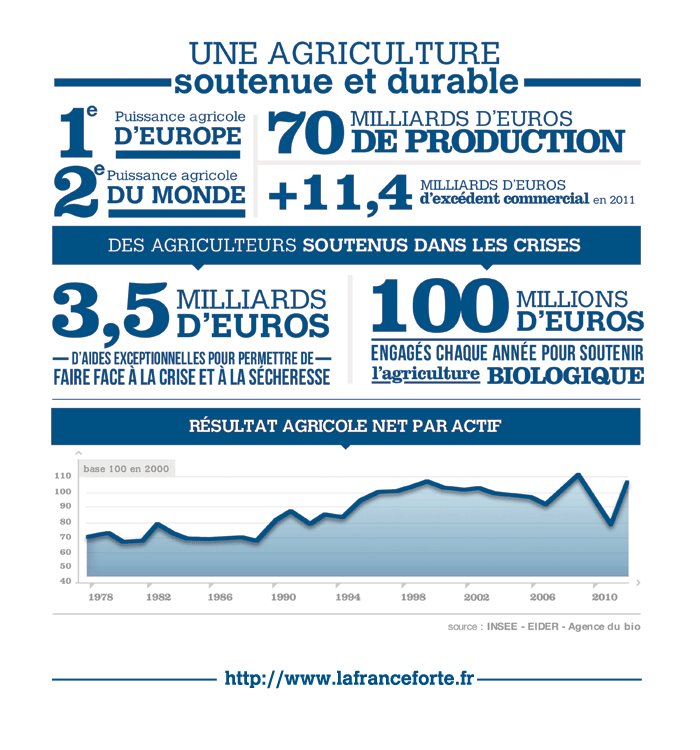
If you’ve been following the French presidential elections closely, you’d have noticed the Sarkozy camp has been sharing attractive-looking infographics of his achievements while in office. Here are a few examples:

Well, you get the idea.

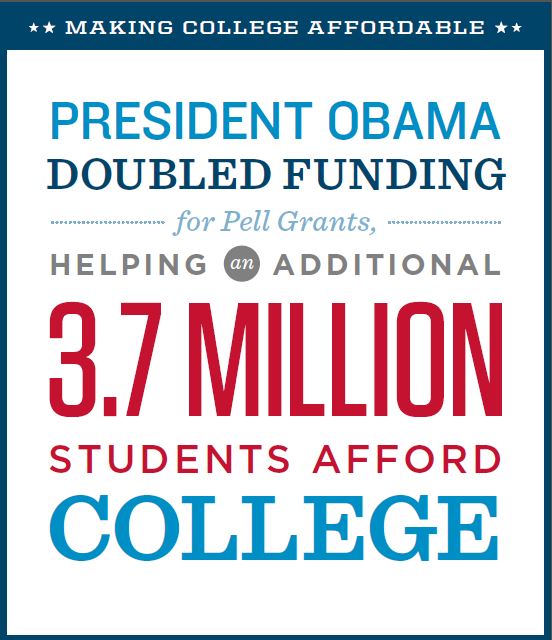
Recently, I saw on Barack Obama’s twitter account a very similar infographic released as well:

The resemblance between Sarkozy and Obama’s posters is uncanny: the colors, the style, the font size, etc….

The first Sarkozy image of the sort was shared on April 17th. The one by Obama was released on April 28th. I would be more inclined to believe the Obama campaign is taking a few hints from the Sarkozy camp, seeing as the latter’s campaign is wrapping up with the final round of elections set for next week.

With the American elections set for November, I’m sure we’ll see much more posters like these from the campaign office of Mr. Obama.