Lebanon… The Diesel Exporter

Our race towards oil exportation has suddenly raced lightyears ahead! Who knew we’d start sending out fuel to neighboring countries in February 2013? Suck on it, Israel!

I can’t believe I’m actually saying this but for once I congratulate the thugs of Tripoli for what they did this morning as they ruined what some politicians had hoped would be an easy travel of diesel tanks into Syria.

Gebran Bassil, minister of energy in Lebanon’s famed “neutral” government, has been sending copious amounts of diesel to help the Syrian regime in its war. Let’s disregard for a moment that this is breaking a multitude of international sanctions regarding Syria, especially when it comes to energy. Let’s ignore for a second that this diesel will end up in tanks whose only job these days is to kill as many innocent people as possible.

This neutrality policy that our government speaks of exists how exactly? Let’s stop hiding behind that vine leave and say it: neutrality my ass.

Our PM Najib Mikati is the only one in this government who truly wants a neutrality stance regarding Syria. Everyone else is either rooting for the regime secretly or is part of parties which are actively fighting with the regime, their people coming back here in body bags. But don’t let them think we know.

Our government’s neutrality position regarding Syria is akin to a class of students where everyone is talking except the teacher – and we tell everyone the class has model behavior.

I am appalled that people in our government can actually fathom sending diesel to help a regime in committing countless and growing war crimes. I am appalled that we are sending fuel to the Assad regime instead of giving this diesel for needy people across Lebanon – because killing Syrians definitely trumps whatever that fuel could be used for here.

Gebran Bassil – the parliament member wannabe who will lose for the third consecutive time this election round – should stick to bringing electricity boats over here and spewing sectarian and racist hatred instead of becoming an accomplice to wars and dragging the whole country with him. After all, it’s not only about diesel. It’s about the confrontation that sending diesel to Syria means in a country that is barely holding it together with its deep division over the Syrian matter.

Lebanon’s Arguileh Militia

Soon after I blogged about how the Beiruti restaurant Enab, situated in Gemmayze, was violating the smoking ban despite stickers announcing the place as a non-smoking restaurant (link with pictures), IndyAct Lebanon decided to take matters in their own hands after a growing number of complaints regarding that particular restaurant were met unanswered by our tourism police.

As I said, it’s obvious there’s an under-the-table deal somewhere that benefits off our lungs. Anything for that extra money.

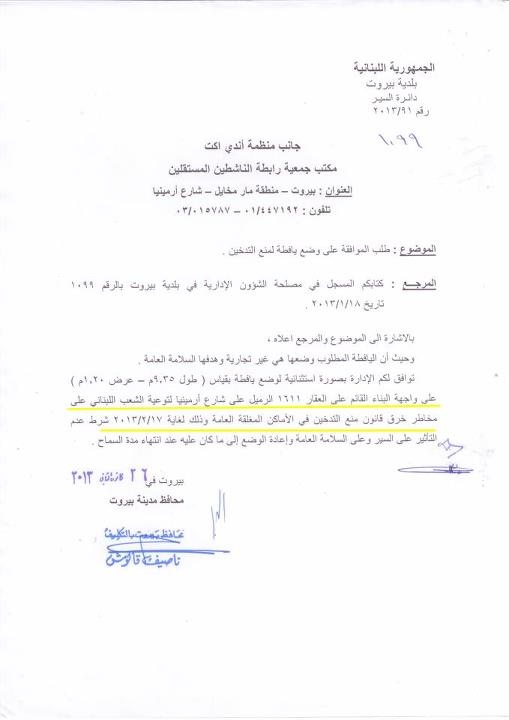
IndyAct decided to use their office space, which is ideally situated next to Enab, in order to set up a huge banner announcing to people who frequent Gemmayze that the restaurant nearby is violating the law and that it is not, in fact, a smoke free place as it advertises. The people of IndyAct were surprised to find their premises violated soon after by employees of Enab who took down the poster. Apparently they wanted to break the law in peace.

And it has all been documented on video:

Soon after the incident, IndyACT procured an official permit from the municipality of Beirut to set up the poster that Enab’s employees forcibly removed. Let’s hope those employees don’t break yet another law by removing the poster.

Enab Gemmayze Smoking Ban


It is said apathy is the weakest point in applying the law. It is our duty as Lebanese to make sure our law is enforced, people constantly said. But I have to ask: what’s the point?

When restaurants such as Enab break the law so flagrantly and have no problem breaking it even more to cover up the initial violation fully knowing they won’t face any repercussions whatsoever, what’s the point?

The more I call that magical 1735 number, the less cooperation I find from the tourism police whose job, paid for by my taxes, is to ensure such laws are enforced. The smoking ban is dead, despite some politicians wanting you to believe otherwise.

The amount of restaurants violating the law today is way too big to count. There isn’t a restaurant in Jbeil or Batroun or Tripoli – the places I spend most of my time in, apart from very few select places like Crepaway, which is actually observing the law. And they don’t even care about it. When you ask them about the smoking ban they reply: “that little thing? No, there isn’t such a thing over here. Do you want an arguileh, sir?”


The solution that I have found suits me best is to reward those few restaurants that are actually observing the law by frequenting them more often. On the other hand, I have decided that when I visit a restaurant that turns out to be violating the law, I will simply leave making sure they know all the smoke in the air is the reason for my departure. They want to make money off arguileh? Well, it won’t be my money they’ll be taking.

While our minister of tourism panics over the decreasing number of tourists visiting our beautiful country and sets up promotions to boost the sector, I have to wonder: how can you expect those people who come from much more organized countries to visit a place where even arguile has its own mini-militia?

I have said it before and I’ll say it again: I will personally never visit Enab, Jbeil’s Feniqia (link) or any restaurant that violates the ban for that matter again. I invite you to do the same.


A Visit To Bab El Tebbaneh

I recently visited an area of Tripoli that few want to think of, let alone set foot in: Bab el Tebbaneh. After my visit, I can see why. Even though the area is only a 25 min drive from home, it makes you feel like an outsider to your own country: nothing about you fits there. The people don’t want you to fit there. You don’t want to fit there.

The people of Bab el Tebbaneh thought I was a foreigner. I found it odd at first – we all share the same identification papers. But I later took it to my advantage. It’s much easier to pretend to be a gullible foreigner who has no idea what he’s doing than to try to reason with them using your native tongue. A foreigner can get away with more.

A few years back, when I used to visit the area’s vegetable market frequently, the people seemed to be much more at ease. They were poor back then as well and they were without prospects back then also. But they were hopeful. Little hope can be found in the faces of the people of Tebbaneh anymore. My visit to Bab el Tabbaneh exposed me to a section of our Lebanese society that is in constant paranoia – of that outsider walking among their shelled buildings, among their tarnished markets, violating their area.

We tried to delve deeper into Tebbaneh but faced resistance the likes of which I hadn’t seen in Lebanon before. We went up a flight of stairs that seemingly led nowhere only to have young men come out of nowhere to ask us what we’re doing there. Somehow they thought we were an “archeological team.” They let us through. Moments later they came back: “But there’s no archeology up this way.”

Bab el Tebbaneh is now a place where you are not allowed to take pictures and where you being out of place might warrant the Lebanese army to come hassle you as well. The people of Bab el Tebbaneh who were more than welcoming way back when look at every outsider suspiciously now. Their eyes will stalk you like a hawk whenever you move, tracing your every step, wondering what your plans are.

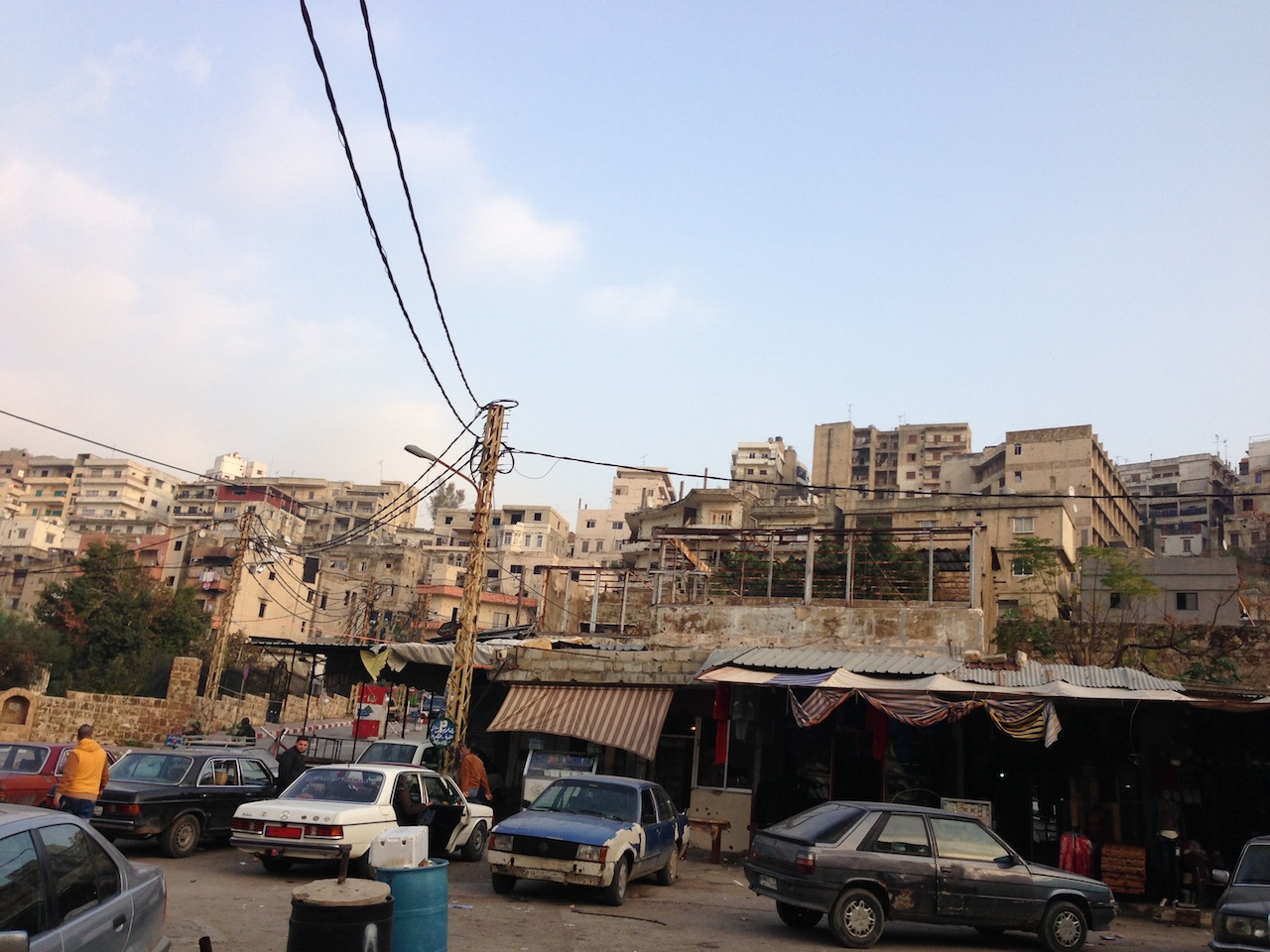
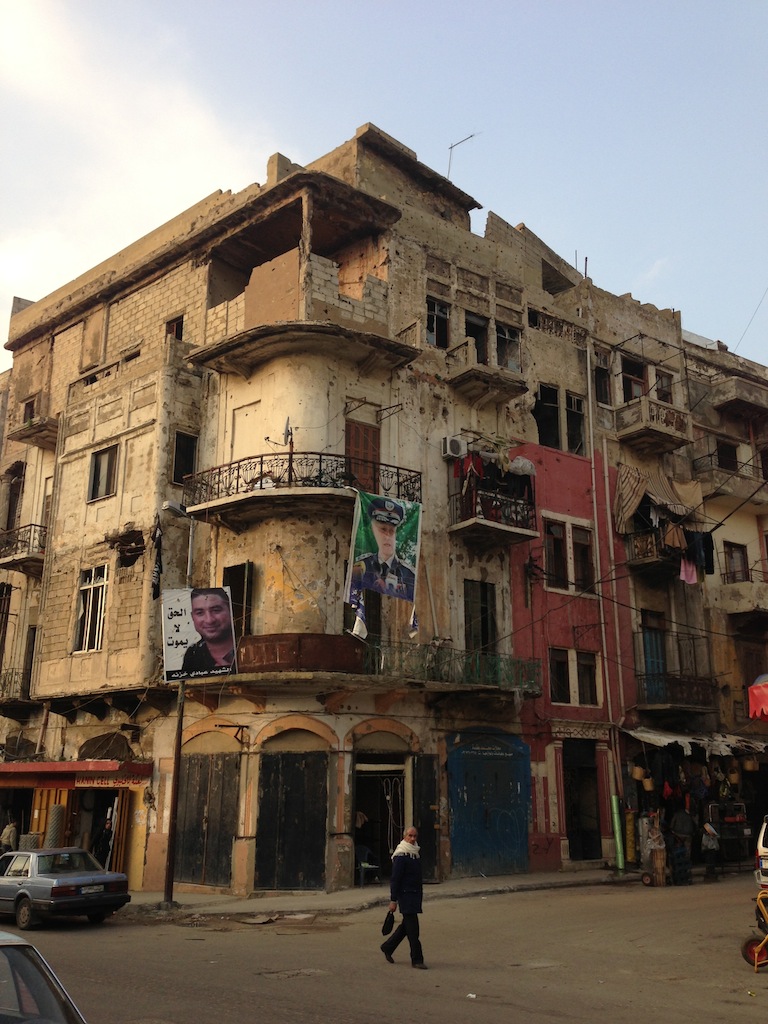
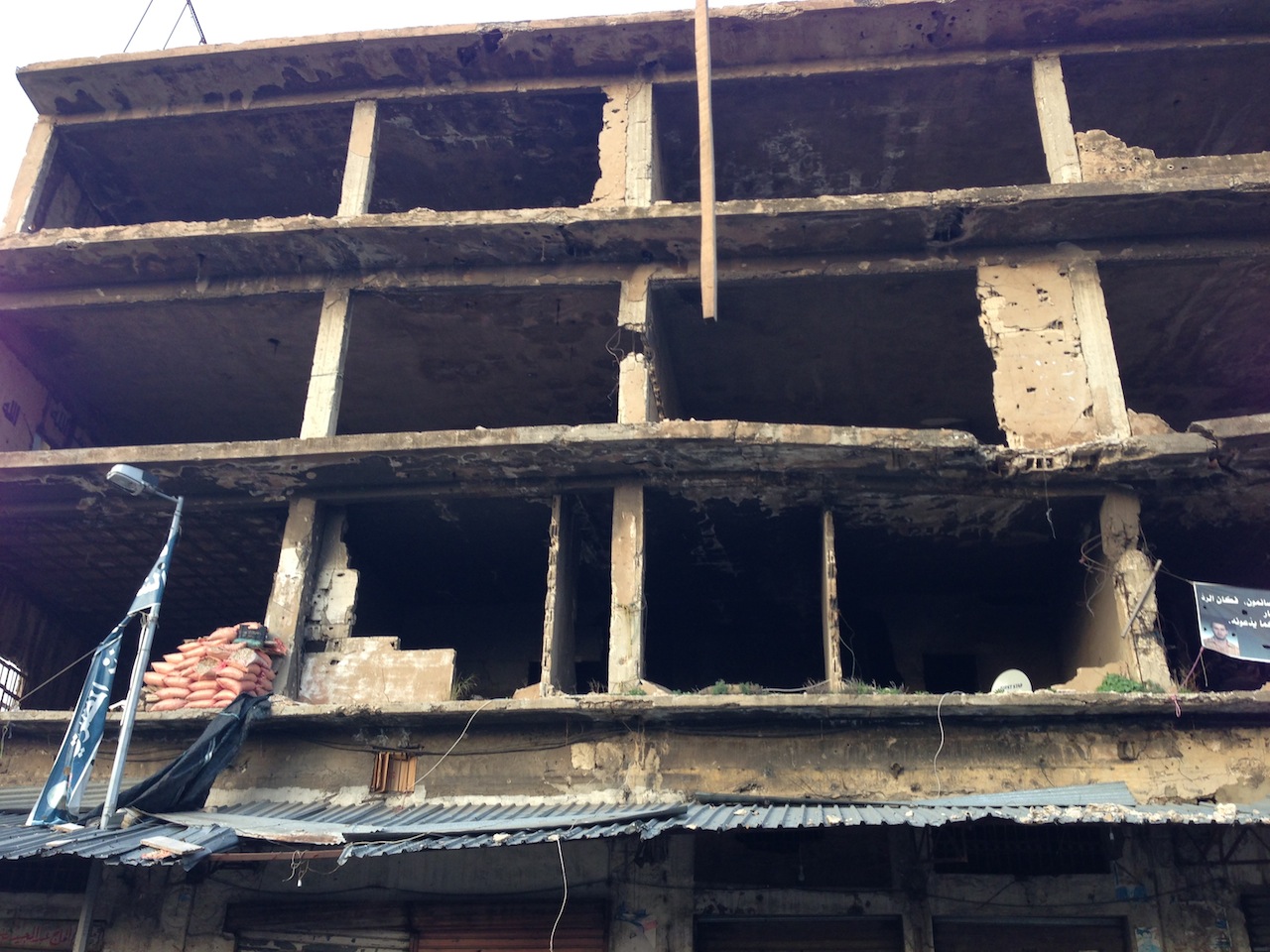
It is an area where the mosques are shelled, where little kids feel that those semi-demolished buildings are a point of pride and want you to go check them out. It’s a place where poverty is so entrenched in every fabric of that society that you have absolutely no idea how or where to start fixing.

“We are all poor people here,” a man came up to me and said, smiling, as I made my way through his street. “You won’t see anything but poverty.” I smiled back and moved on. There was really nothing I can do.

Where can one start? The politicians promise these people better lives every four years and end up doing nothing. They are untouchable. The religious men who sport the latest cars and equipment use these people’s poverty to their advantage in order to radicalize them. Factions use these people’s needs in order to carry on with their battles after handing them copious amounts of weapons. Most Lebanese hate the people of this area and the “image” they give their country and are more than willing to bash them in and out.

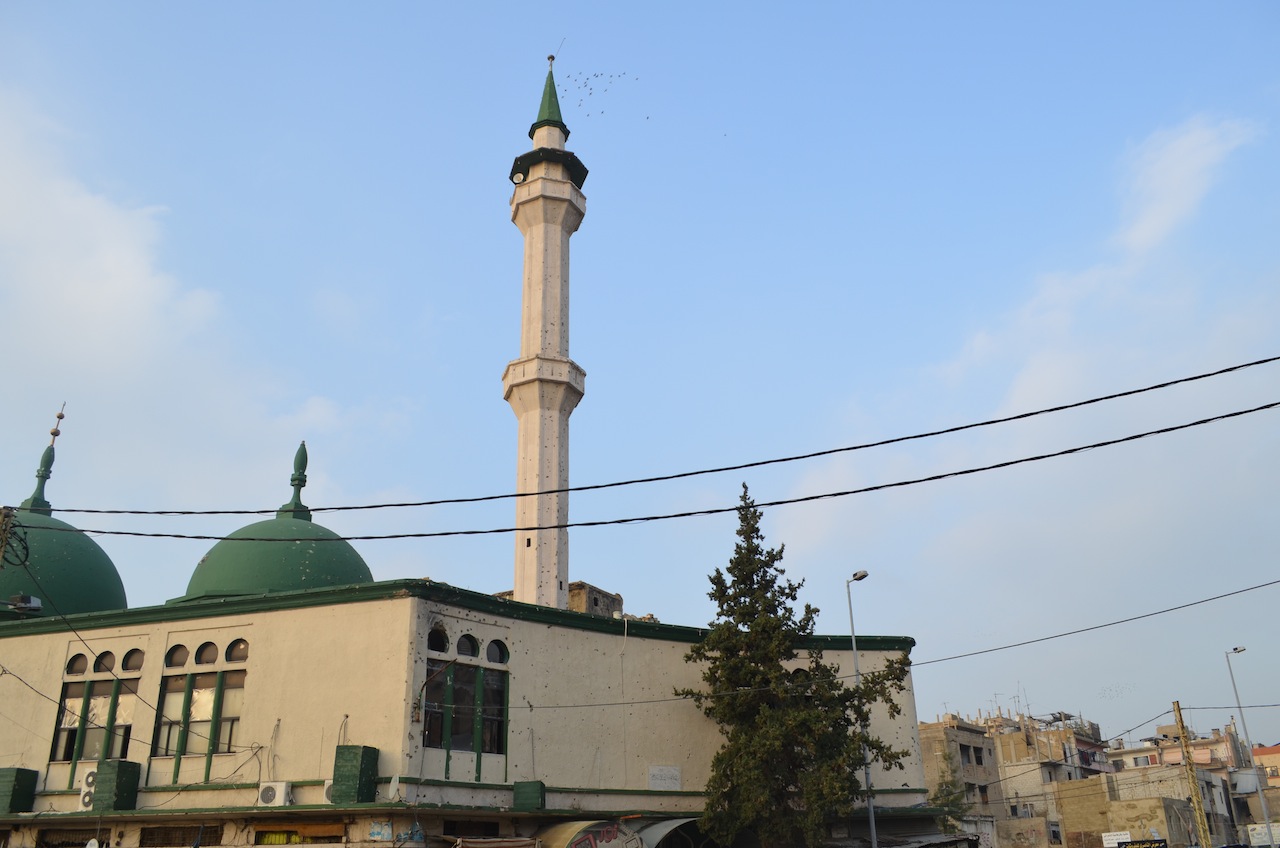
As we reached the point of saturation of what little we got access to of Bab el Tebbaneh and made our way out, as a man shouted at us not to take pictures anymore, another stopped us and pointed at a mosque whose walls were filled with bullet holes. He was exasperated by all the fighting. But he knew there was nothing he could do.

I would be lying if I said I wasn’t relieved when I reached the newer parts of Tripoli. It’s hard to imagine how this poverty can be found at a stone’s throw away from the house of one of Lebanon’s richest men. Then you realize that all of Lebanon’s richest men feed off this poverty and help perpetuate it. It’s how they remain powerful.

The mosque and its bullet holes.

The mosque and its bullet holes.

The section we couldn't visit

The section we couldn’t visit

"Come see all the destroyed houses."

“Come see all the destroyed houses.”

"You can't take pictures here."

“You can’t take pictures here.”

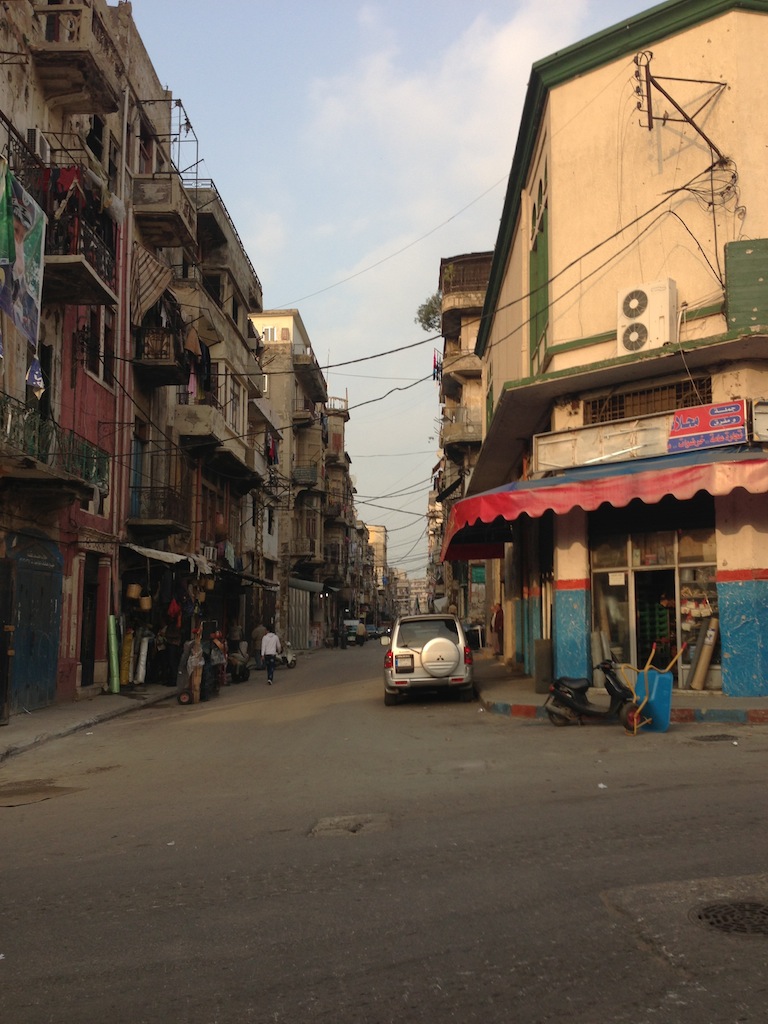
People used to live here.

People used to live here.

The Sleepless Nights of Lebanon’s Tripoli

If you go by the geography they teach at Lebanese schools, you are taught that Tripoli is the second biggest city of Lebanon and the capital of its Northern governorate.

The geography they taught us at school also enumerated the numerous economic riches that Tripoli boasted: its port, its proximity to the border, etc….

The civics course they gave us at school tells us about the numerous touristic advantages of the city of Tripoli: its castle, its old souks….

The sociology they taught us at school mentioned how Tripoli has one of Lebanon’s poorest regions on its outskirts. It’s mentioned only fleetingly, like something we can’t wait to bury under a pile of blissful ignorance as if it’ll make everything okay.

If you look at the latest events taking place in the country, you’d think our Northern border is not at “Al 3arida” but at Balamand. You’d think those Lebanese people of Tripoli have been annexed to the Syrian war. You’d think that this Lebanese city that many find too easy to hate is no longer Lebanese – just a burden that we can’t wait to get rid of. Let’s return it to pre-1920 days when it wasn’t part of our favorite part of Lebanon, Mount Lebanon.

My friends in Tripoli haven’t been sleeping lately. But you’re not hearing about that. You’re not hearing about the explosions going off at any moment, the bullets piercing through the silent December nights. You’re not hearing about the people dying, the children getting shot.

You’re not hearing about the people like you and me cowering away at a corner of their house all night in fear that one of those stray bullets might do them in.

It seems as if our Lebanese media has washed its hands from Tripoli. That city is just not worth the coverage – it’s a “been there done that” type of things. They’ve covered similar incidences there before. What’s the use of covering them now? It might go well with their policy of “let’s show only the good side of Lebanon for the world in order to save the Christmas tourist season.”

Our politicians couldn’t care less as well – as long as they get their share of votes next year. This city, which has one prime minister, four ministers and a bunch of MPs, has no one to speak on its behalf. It only has people who preach about what should take place as they sit in gilded seats somewhere far, far away.

“We condone the presence of arms in the city.” You often hear say. And what will your condemnation really do, mr. politician, while you’re the one secretly buying your people weapons in order to fuel the struggle that you know will bring you loads of returns in a few months’ time?

I am not from Tripoli. But Tripoli is one of my favorite cities in this God-forsaken country. It saddens me to see ignorants portray my friends as a bunch of Islamists who deserve whatever’s happening to their home. It saddens me to have people panic beyond their minds how I had to drop off a friend in Tripoli around midnight a couple of days ago. It saddens me that with each passing day, Tripoli is stripped from the identity of a city where Muslims and Christians lived side by side for years and is portrayed as a place where the next Islamists Emirate will start from.

When it comes to Tripoli, the majority of Lebanese have one thing to say: “On n’est pas concerné.”

The Syrian Army Attacking North Lebanon Tonight?

A news report just published is saying that more than 15,000 Syrian army men are heading towards the Northern Lebanese borders for a military attack to secure the border. The report also says that the Syrian army might venture deep into Lebanese land and reach Tripoli to completely annihilate the support of the Syrian Free Army in North Lebanon.

I’m taking this with a grain of salt because it sounds too far-fetched, not to mention that the source of the news is Al Diyar. Why would Bashar el Assad risk 15,000 men away from battlegrounds where they’re probably much more needed?

But I’m not a military strategist nor do I want to be. So assuming that there’s some truth to this and that the Syrian Army might be planning something eventually along the Lebanese border, let me ask our government a few questions:

  1. Have you made sure that the Syrian Army is not moving in droves towards our Northern border?
  2. If the Syrian army is moving in droves towards our border, have you called your favorite person in Damascus to ask them why?
  3. Have you called up upon our army to move towards Akkar in order to retaliate to every single missile and shot fired by people who want to violate our land? Or is it only violation and a cause of panic and mayhem when our Southern neighbors do it?
  4. In case the Syrian Army decides to go as far as Tripoli, do we have a plan of action or will we just stand by the sidelines and watch as they burn our country again?
  5. PM Mikati, how was your pilgrimage to Mecca? Rewarding, I hope.

Alas, the answers to all of those questions are already known. Long live a country whose borders are as open as the legs of a prostitute.