Stories of Lebanese on the Titanic – Part 4: Two Men from Toula & Zahle

For part 1, click here. Part 2, click here. Part 3, click here.

Toula is a small town in the Batroun region which had only one person aboard the Titanic, named Fahim el Zeanny. Seeing as his name is difficult for foreigners to pronounce, it was changed in Cherbourg to Fahim Kini before it changed, yet again, once he got to New York, to Philip el Zeanny.

Philip left Toula at the age of 23, leaving in Marseille his wife whom he married 4 months prior so he can settle down and start his own business in Cincinnati before she follows him. Philip wrote down what he went through on the Titanic.
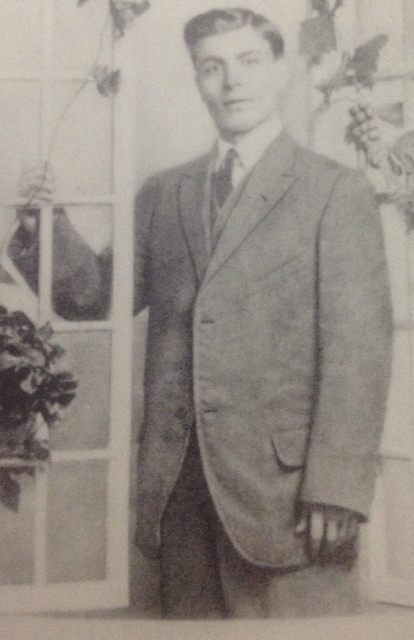
Philip, 2 years before his death.

On the night the ship hit the iceberg, he was fast asleep. One of the passengers woke him up hastily and told him what was happening. So Philip started panicking, as was everyone around him. He then ran to the deck where, still panicking because of what he had heard moments ago, he got into a rescue boat. The officer, though, forced him off and threatened him with his gun, saying: women only.

Philip then used the chaos around deck to his favor and got into a second rescue boat. That same officer, however, saw him and forced him off again. Moments later, Philip got past that officer and hid under the seating flanks of one of the boats. That boat was lowered into the water. It only had two men who couldn’t row it away from the ship fast enough with more than twenty women on it. So Philip made his presence known and helped them take the boat away from the Titanic.

Then they waited and watched as the ship sank. The shrieks coming from the passengers who were thrown in the water were deafening.  Philip urged them go back but no one agreed. More lives could have been saved. As he looked around his rescue boat, Philip was apalled by one woman who brought her pet dog with her. The dog was big enough for another person to take its place.

Once the Carpathia arrived, the woman said sternly to Philip, whom she thought shouldn’t have been on board with them, to help her carry the dog as she got on the Carpathia. Philip refused, telling her that the souls of people are more important than those of animals.

Philip ended up passing away on 1927, fifteen years later, leaving a family of four children behind.
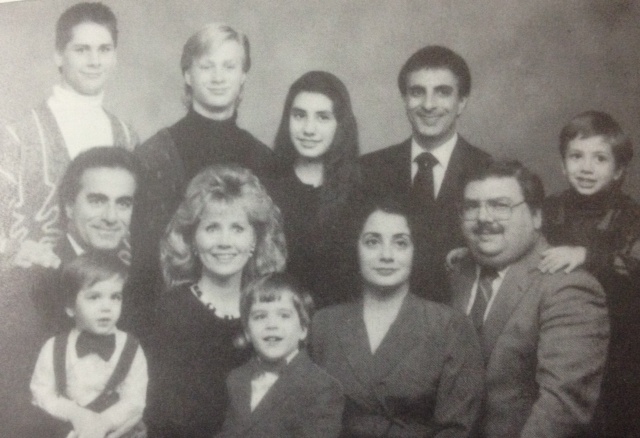
The descendants of Philip

On the other side of Lebanon, Zahle had the only Lebanese passenger not in third class. Nqoula Nasrallah and his wife, Adele, were both second class passengers. Nqoula left Zahle at the age of 28, to go to San Francisco where his uncle had started a successful movie franchise.

Seeking the fame and fortune that his uncle had already found, Nqoula took his wife and got on the Titanic. On the night the ship sank, Nqoula got his wife on a rescue boat while he jumped into the water and started swimming away, hoping like other swimmers, that the vests they were wearing would keep them afloat until the rescue boats arrived. His hope was out of place.
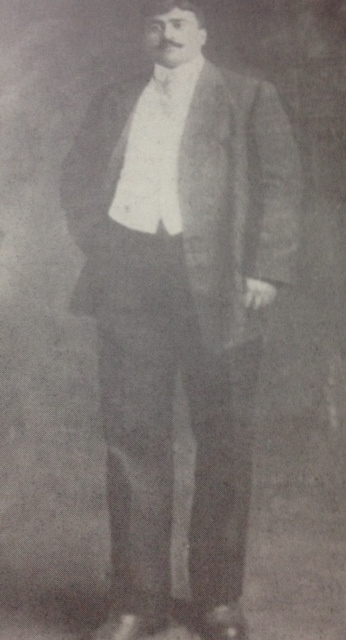
As Adele’s rescue boat moved away from the ship, she saw her husband swimming away. So she stood up and started shouting with every bit of strength she had for him to come on board. But amid all the chaos of all the people in the water around her, Nqoula never heard her. He kept swimming and swimming until he could swim no more.

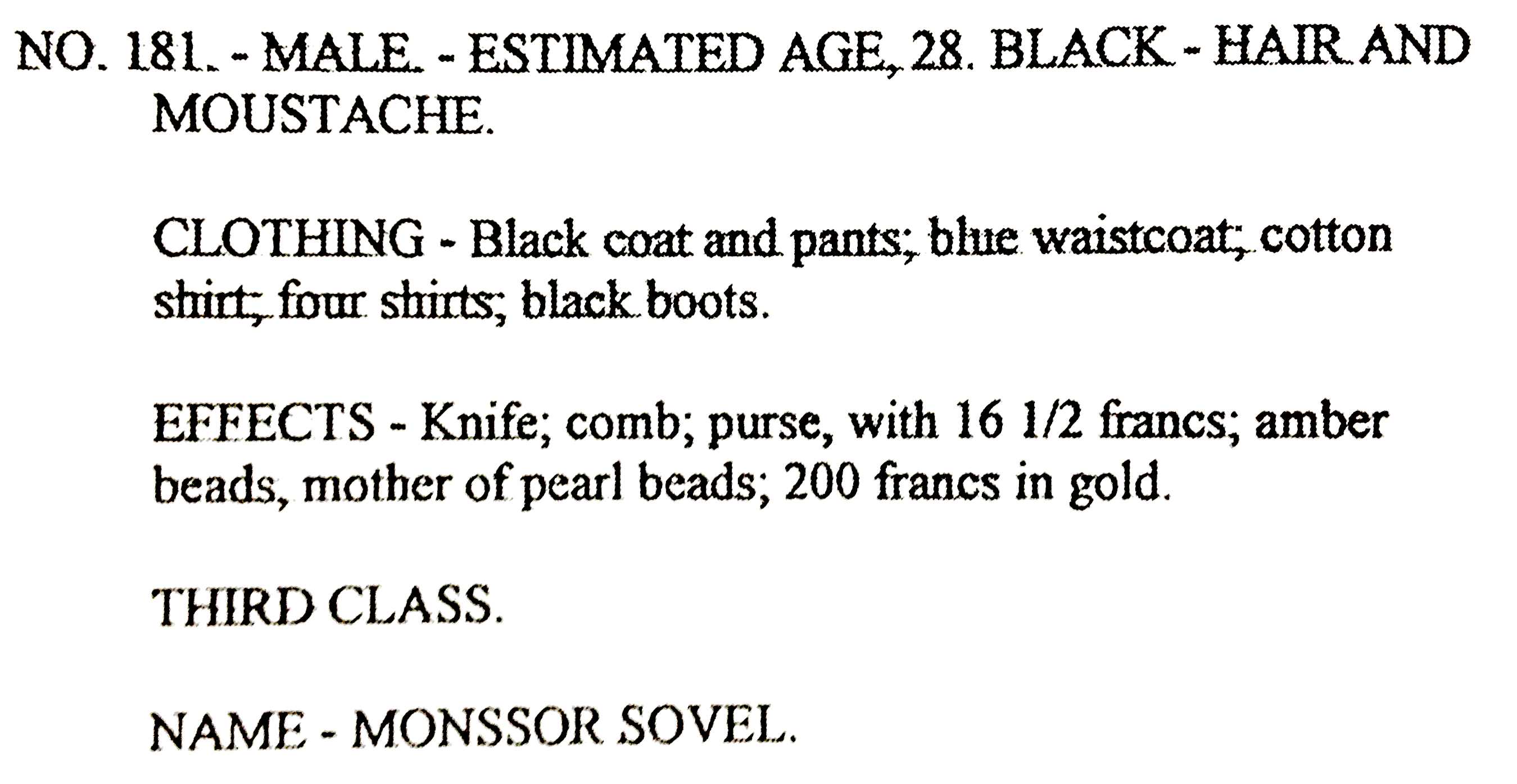
On April 24 th, 1912, the MacKay-Bennett found Nqoula’s body which was thought to belong to the millionaire John Jacob Astor. The following description of the body was given:
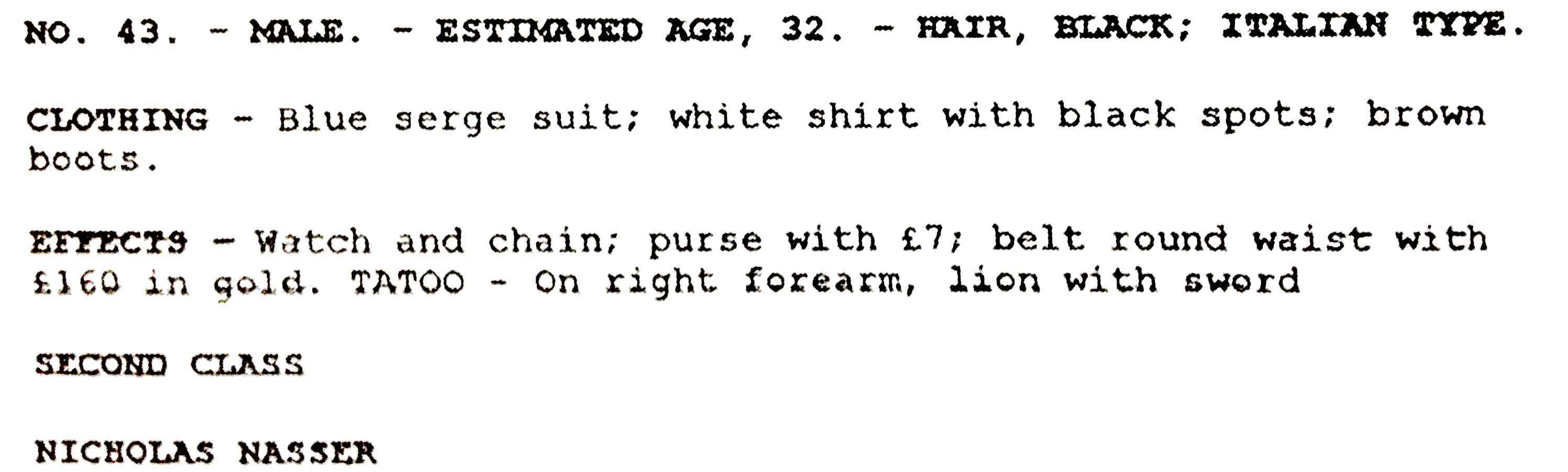
Nqoula’s mother, Wardeh, was devastated by the untimely passing of her son. So she went out on Zahle’s very cold winters outside and sat, as snow piled up on her, so she can have a taste of what her son went through in the freezing water of the Atlantic. Wardeh’s granddaughter Emily told how her grandmother used to go outside and put her hands in a frozen pond just so she can feel closer to her son.

Adele was pregnant when she was rescued. She gave birth to a baby boy on December 9th, 1912. The boy died soon afterwards. Adele remarried and had a family of four children. She died on January 20th, 1970.

Part 5 will be coming tomorrow.

Spare Us The Samir Geagea Hate

I told a civil war story last year that I made ambiguous on purpose to reach a certain conclusion, which was that everyone’s to blame for the Lebanese civil war if we really want to move the country forward.

However, I recently realized that Lebanese need a scapegoat for them killing each other. Their scapegoat was chosen to be Samir Geagea.

For some, Geagea killed them because they were of a certain religion, region, background, etc. For others, their sense of guilt kicks in and Geagea killed the aforementioned people because of their religion, region or background, as well as some of them who were “strong” enough to defy him.

The murderer! The liar! The assassin! The faithless! The abomination!

For many apparently, Samir Geagea was fighting the air during the Lebanese civil war. He was drawing his weapons against everyone but no one was drawing their weapons against him or his party.

For many it seems, Samir Geagea and his party were busy ruining the country all by themselves during the Lebanese civil war. No one else did anything worthy to be mentioned.

For many, the only war criminal of the Lebanese civil war is Samir Geagea. As if it’s possible for Samir Geagea to lead a whole civil war all by himself.

You defend Samir Geagea? You’re an accomplice to his murders. You complement him? They expected so much more of you. You admire him? You need to learn your history.

Because they know their history very well, I’m sure. Every single Lebanese now has a PhD in Lebanese civil war times and I was out of the loop. It’s sad.

The illusion that some people are innocent because they were legitimate needs to be removed. A bridge needs to be built and people need to get over that idea en masse. The fact that certain parties were violent to certain guests on our land can only be explained by the actions of those guests in a land that’s not theirs. The actions of certain parties cannot be taken out of the context during which they were carried out and treated as stand-alone events. It simply doesn’t make sense, regardless of how hideous those acts may be.

The civil war is an uncivil epoch.

No one in the civil war was a saint. If those involved had been as such, it wouldn’t be called a war and we would have had a very civil era. It’s far from being the case.

So let me put the situation today in the following manner.

If during the war your car was ruined? Blame Geagea. Your house was set on fire? Blame Geagea. You got stopped at a checkpoint? Blame Geagea. Your great-great-great-cousin, 2 degrees removed got killed? Blame Geagea.

Geagea barely escapes death? Blame Geagea. Anyone else barely escapes death? Blame Geagea.

Blame Geagea for everything – because that is the way we move forward.

If you’re one of those people who still consider the civil war in making their political choices today, then I pity you. If you’re one of those people who still need a scapegoat for your own mistakes just so you can please your conscience, I pity you.

Spare us the Geagea hate. Spare us the mindless, useless and retro attitude. If your mind is still in the civil war, perhaps getting it out of there is the first step towards building a country, instead of preaching about the importance of change and reform in moving Lebanon forwards.

Change and reform begin on the inside. Change your mentality. Reform your hate. And then come talk to me.

The ironic thing is that Geagea is the only one among all Lebanese political leaders today that went to jail for some of his supposed actions. Everyone else faced next to negligible consequences.

Tenzeker w ma ten3ad? At this rate, yeah right.

Stories of Lebanese on the Titanic – Part 3: The People of Kfarmishki

For part 1, click here. For part 2, click here.

Out of all the Lebanese villages that sent its sons and daughters to America on the Titanic, Kfarmishki has the highest death toll at 13, out of the 14 people that wanted to reach Ontario, Canada where most of the town’s expats reside.

Out of the 13 people that kfarmishki lost, only one body was recovered. Everyone else was lost, never to be seen again or given a proper burial. The abyss of the Atlantic became their final resting place.

Of those whose bodies were never found, there’s Assaf el Saykali who left his newly pregnant wife in order to find a way around the poverty in his hometown. Another is Mansour el Hajj, who left his 3 year old daughter and wife, only to be taken in by the sea.

The only body that was recovered through the MacKay-Bennett belonged to Mansour Nawfal, a man in his late twenties who had left his hometown searching for a better life all by himself. Almost none of the people of Kfarmishki know about him. The MacKay-Bennett’s crew wrote his name as Mansour Sovel on the medical form they filled upon collecting him on April 24th, 1912.

The only survivor from Kfarmishki was a woman named Zad Assaf, who is more commonly known as Mariana Assaf. The name discrepancy arose when she was rescued and asked for her name. Being illiterate, she couldn’t inform the personnel of her proper name so on the lists of survivors, she became known as Mariana.

Zad was born in 1867 and got married in her hometown before leaving it and her two sons to follow her husband to Ontario. In 1912, she returned to Lebanon to see her sons and got on the Titanic, via Cherbourg in France, to go back to her husband. Her sons would soon follow her. It was a good thing they weren’t on the Titanic with her.

While being interviewed on April 24th, 1912, a traumatized Zad told the story of what happened on the day Titanic sank. She said when the ship first hit the iceberg, none of the passengers she was with, most of whom were Lebanese, got afraid. They had called it a night and went to bed. The lack of fear was due to them not knowing the gravity of the situation. It had been kept under wraps for as long as the crew could do so. Some of the Lebanese, however, wanted to go on deck to see what was happening. They were told nothing was wrong and no one felt any danger. So they stayed in their rooms.

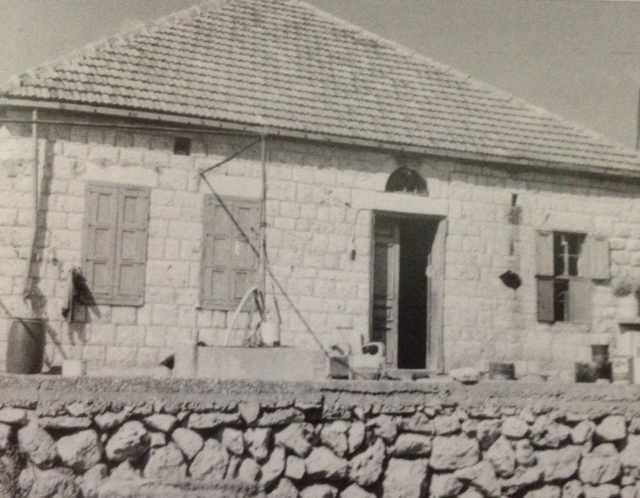
Zad Assaf's house in Kfarmishki.

As time went by and the ship didn’t move, their minds started racing and thinking about what the crew could be hiding from them. Some had started to think about the possibility that the ship might be sinking. Suddenly, one of the passengers shouted that the ship is sinking fast. That was then the chaos began and people started running frantically to the deck of the ship, not caring how they got there as long as they did.

Zad said her mind went numb. The only thing she was able to think about back then was to get to the deck where first class passengers had already been. She got to there with a man from her hometown named Elias Tannous Nasrallah, a 22 year old who had left his wife in Kfarmishki. He was going to Ontario to provide for her. As he neared the rescue boats, Elias tried to reason with an officer there to let him on. The officer wouldn’t let him. The chaos that ensued and Elias still pleading for his life got the officer to hold his gun at Elias and shoot him in the chest, killing him instantly, saying: women and children go first.

Shocked by what happened to Elias, Zad froze in her spot. She couldn’t move. The shock of the ship sinking was just made worse by seeing the man from her hometown murdered right in front of her. Without her being aware of it, a navy officer pushed her into a boat full of women and a few men. The boat was then lowered to the water and the men started rowing away as the ocean engulfed Titanic.

Some of the survivors had said the music band kept playing until the very last moments. Zad wasn’t aware of that. She was still in shock. She was among the last people to be lowered off the ship, an hour and thirty minutes after impact. Stranded at sea, they stayed there for hours, freezing in the cold. Six hours after leaving Titanic, the ship Carpathia came to their rescue. The only thing she was able to remember was them offering her warm clothes.

Once she got to New York, she was admitted to the hospital for observation. Once discharged, people from the area helped her get to Ontario where she met her husband. Her sons soon followed her. One of them later on went to Sao Paolo where he lived to be over 105 years old.

Elias Nasrallah’s wife got remarried in Kfarmishki after getting the news that her husband has passed away.

Stay tuned for part 4 tomorrow.

Carrie Underwood’s Good Girl Gets HAC Ads Date – Crossover Attempt?

Good Girl, the lead single off Carrie Underwood’s fourth studio album, Blown Away, will be given a chance to crossover to formats other than country where it currently sits at #8, 6 weeks after being released.

On April 23rd, Hot Adult Contemporary format radios (HAC) are invited to add Good Girl to their rotation. The song is currently #42 on the HAC charts, due to airplay from stations that added it upon requests.

This is Carrie’s first song since Before He Cheats (Last Name got an adds date but was later pulled) to get an adds date for a radio format other than country.

I guess crossover promotion is a go. If Good Girl turns out to be a hit on HAC, Top 40 won’t be that far off.

Smeds Knefe and Pizza ads: Sex, Breasts & Food?

The new ads by Smeds for their mozarella cheese are nothing but sexually inferring. Without them telling you what they’re advertizing, you’d think Antoinette Akiki has a new sex-ed show, à la Lezem Ta3ref, on YouTube.

I’m not a marketing expert. But if someone intends to sell some food item, is associating it with talk about breasts and a man bringing his wife to orgasm a decent strategy?

In other words: food and vulgar ads, do they go hand in hand (no pun intended) or is it a grave misstep here?

I’ll leave the answer to the pros.

To me, I think sex sells. But not cheese.

Here are the ads: